
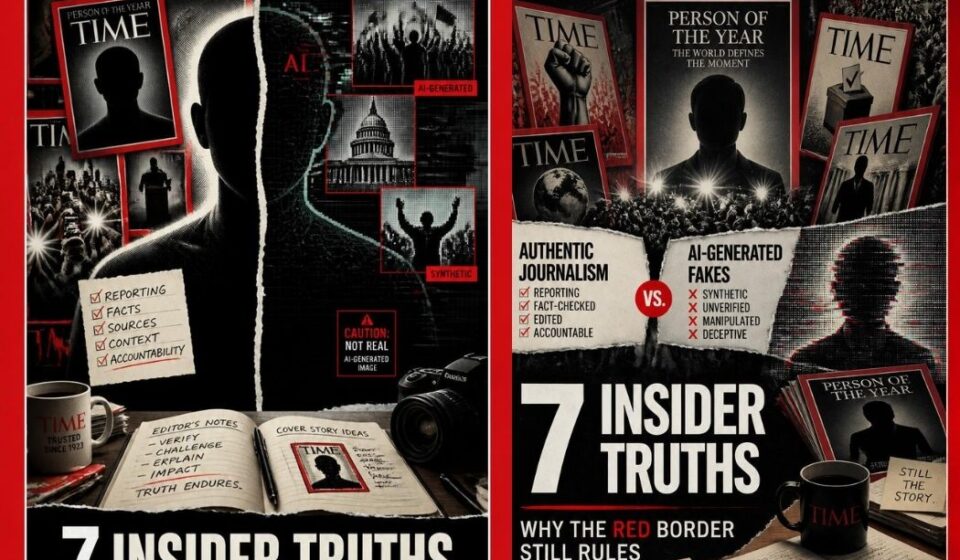
What single image could make a U.S. president bristle, spark 800,000 social media arguments in hours, and sell over 200,000 copies on a newsstand in a single week?
The answer sits on newsstands, in doctor’s waiting rooms, and increasingly on your phone screen: the Time magazine cover. For over a century, that thick red border has functioned as a global stage where presidents, pop stars, tech titans, and controversial ideas compete for the world’s attention. In 2026 alone, Time has already sparked international debate with a MAGA hat cover that divided even Trump’s own base, placed Christian Pulisic on the cover ahead of the World Cup, and watched as AI-generated fake covers of Australian PM Anthony Albanese circulated online.
But why does a magazine cover—a format many predicted would die in the digital age—still matter so much?
This isn’t just about a magazine. It’s about the mechanics of influence, the art of provocation, and the strange power of a single frame to crystallize a moment in history. Whether you’re a media professional, a design enthusiast, a marketer studying viral content, or simply someone who’s ever wondered who decides what goes on that cover and why, this guide will take you behind the red border.
Let’s pull back the curtain on the most powerful piece of real estate in journalism.
Background: From 22 Sections to a Global Megaphone
The Birth of an Icon (1923)
Time wasn’t supposed to look like this. When Henry Luce and Briton Hadden launched their “news-magazine” in March 1923, the first cover featured a charcoal portrait of retiring House Speaker “Uncle Joe” Cannon—a far cry from the bold red frame we know today. The name “TIME” itself was chosen over alternatives like “Facts,” signaling something revolutionary: a publication that would organize the chaos of global news into digestible, personality-driven narratives.
The founders had a conviction that would define the magazine for a century: people don’t just make news—they make history. As Luce and Hadden believed, “destiny as personality” meant that almost every cover should feature a person or persons. This wasn’t just editorial philosophy; it was a commercial strategy that made Time a cultural institution.
The Red Border and the Making of a Brand
The iconic red border took four years to arrive, but once it did, it became one of the most recognizable visual identities in publishing history. Former managing editor Jim Kelly once noted that the red border was “both a great asset and a great responsibility”—the implicit message being that “a story has got to be awfully good to deserve that red border”.
By the time Time celebrated its centennial in 2023, it had published over 5,000 editions and created a visual archive of global history. The March 3, 2023 centennial issue alone featured 144 mini-covers framed in the red border—a snapshot of a century’s worth of impact.
How Person of the Year Became a Cultural Event
The tradition that would become Time’s crown jewel began almost by accident. In 1927, editors realized they’d neglected to feature Charles Lindbergh—the year’s biggest story—on the cover. To remedy the embarrassment, they named him “Man of the Year” for the year-end issue, and a tradition was born.
Initially rooted in the “Great Man Theory” of history, the honor typically went to politicians, industrialists, and world leaders. Fourteen U.S. presidents, five Russian leaders, and three popes have received the designation. But Time has also courted controversy with choices like Stalin, Hitler, and Ayatollah Khomeini. In 1999, “Man of the Year” became the gender-neutral “Person of the Year”—though that year’s winner was Jeff Bezos.
The 2023 selection of Taylor Swift marked a watershed: the first entertainer ever named Person of the Year. Time’s editor-in-chief framed the choice as recognizing someone who “found a way to transcend borders and be a source of light” in a divided world. The numbers backed it up: Swift’s Eras Tour was projected to generate $4.1 billion, and she’d become the first artist to occupy all top 10 spots on the Hot 100 in a single week.
In 2025, Time made another unconventional choice: the “Architects of AI”—not a single person but a group spanning Jensen Huang, Sam Altman, Elon Musk, and others—received the honor, with the magazine declaring that “humanity is now flying down the highway, all gas no brakes, toward a highly automated and highly uncertain future”.
The Anatomy of a Time Cover: Why Some Soar and Others Spark Outrage
The Editorial Calculus Behind Every Choice
Choosing a Time cover is not a casual decision. Former managing editor Richard Stengel called it “the single most important job of the managing editor”—the “one chance we have to break through the media clutter”. Stengel estimated he spent a full quarter of his time “thinking about, executing, editing, regretting covers”.
The economics matter, but less than you might think. Newsstand sales constitute less than 4 percent of Time’s overall circulation, which exceeded 4 million copies weekly in the mid-2000s. Yet newsstand performance serves as a proxy for subscriber appeal: covers that sell well on newsstands tend to resonate with subscribers too. The best-selling issue of 2006—the “Be Worried. Be Very Worried” global warming cover—sold over 200,000 copies versus the ~130,000 average.
The Visual Language of Provocation
Time covers work because they compress complex arguments into single, unforgettable images. Consider the March 2026 cover featuring eight red MAGA hats, each with “America” replaced by a different country name: Iran, Venezuela, Nigeria, Iraq, Syria. The cover story, “Trump’s War,” argued that Trump had “deployed military force in increasingly dizzying ways” despite campaigning as a “peace president”.
The result? Nearly 800,000 views on X within hours, with reactions ranging from praise to outrage—and a fascinating interpretive split where many MAGA supporters thought the cover was celebrating Trump rather than critiquing him. One user captured the genius of the design: “Eight countries, eight red caps, zero words needed—Time made the most efficient political argument of the year without writing a single sentence”.
This is the Time cover at its most potent: visual argument so sharp it cuts through partisan noise, even when (or especially when) audiences disagree about what it means.
The First-Ever Logo Replacement
Sometimes the most powerful cover choice is to abandon the format entirely. In October 2020, for the first time in its nearly 100-year history, Time replaced its logo on the U.S. edition cover with the word “VOTE”. The artwork, by Shepard Fairey (creator of the iconic Obama “HOPE” poster), depicted a woman wearing a bandana with a ballot box and “VOTE” printed on it.
Editor-in-chief Edward Felsenthal framed it as a response to a year of “pain, hardship, chaos and loss,” urging readers to “press the reset button” through their ballots. The cover didn’t just report on the election—it participated in it.
The Masterminds Behind the Covers
For over 25 years, D.W. Pine served as the creative force behind Time’s visual identity, leading the design of more than 1,000 covers. His all-time favorites reveal the range of the form: a minimalist 2025 image of Elon Musk seated behind the Resolute Desk (“sometimes the most powerful covers don’t need a single word”); the 2018 “The Drone Age” cover created with 958 drones forming the red border; and the 2016 “Meltdown” cover by Edel Rodriguez, which used “two simple colors” to create a globally recognized graphic representation of Trump’s campaign turmoil.
Pine’s work demonstrates that the Time cover is not a static template but a living format—one that can accommodate charcoal portraits, drone photography, stark minimalism, and AI-generated imagery.
The 2026 Time Cover Landscape: AI, Fakes, and the Battle for Authenticity
AI Takes the Crown (and the Cover)
The defining Time cover story of the mid-2020s arrived in December 2025, when “The Architects of AI” were named Person of the Year. The issue featured two covers: one illustration depicting workers constructing the letters “AI” on scaffolding, and another showing eight tech leaders—Jensen Huang, Elon Musk, Sam Altman, Mark Zuckerberg, Lisa Su, Dario Amodei, Demis Hassabis, and Fei-Fei Li—perched on a steel beam, evoking the iconic 1932 “Lunch atop a Skyscraper” photograph.
The cover story explored AI’s transformative power alongside its darker implications, including the death of a 16-year-old California boy whose parents sued OpenAI, blaming the company for conversations he had with ChatGPT before his suicide. Time’s editor-in-chief Sam Jacobs wrote that the architects had been “wowing and worrying humanity” and “transforming the present and transcending the possible”.
Not everyone saw it as celebration. Forrester analyst Thomas Husson noted that 2025 marked a “tipping point” for AI adoption—”most consumers use it without even being aware of it”. But Nik Kairinos of Fountech AI cautioned that “recognition should not be confused with readiness,” adding that “AI can still be a saviour or scourge to humanity”.
The Magazine Cover Indicator: A Warning Sign?
Financial contrarians have long noted a phenomenon called the Magazine Cover Indicator: when a trend or company becomes prominent enough to warrant a mainstream magazine cover, it may signal peak enthusiasm before a decline.
In 2026, the cover of Time’s September 7 issue featuring OpenAI founders Sam Altman and Greg Brockman—arms crossed under the headline “Trust Us”—triggered exactly this kind of speculation. The cover met the classic criteria: a mainstream publication, a broadly understood theme (AI), and a multi-year surge in investor enthusiasm.
Critics seized on the “Trust Us” framing. One X user wrote, “‘Trust us bro’ doesn’t work anymore. Time for someone to check what AI is actually doing to humanity.” Adam Ghaida, founder of the AI-powered assistant Orchid, called it “probably the most sinister title they could have chosen”.
Whether the indicator predicts a market top is uncertain—but the cover’s existence itself signals that AI has crossed the threshold from tech subculture to mainstream cultural fixation.
The Rise of AI-Generated Fake Covers
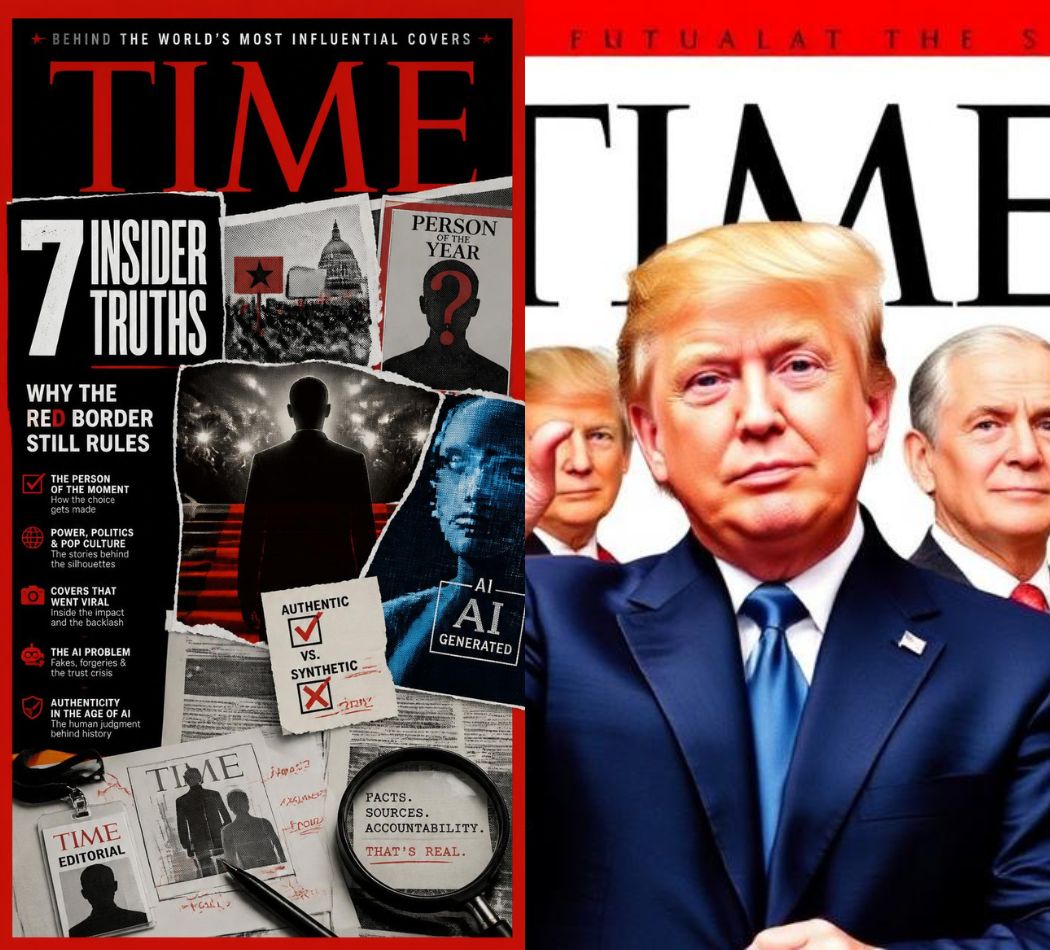
Here’s something most articles about Time covers miss: the cover’s authority has made it a target for AI-generated fakes. In April 2026, fabricated Time covers featuring Australian Prime Minister Anthony Albanese circulated on Facebook, claiming he’d been named among Time’s 100 most influential people. He hadn’t—and the fakes were detectable by telltale signs like a Gemini AI logo in the corner.
A similar case emerged in July 2026, when an edited image purporting to show climate activist Sonam Wangchuk on Time’s cover spread online. Time had actually run covers that month featuring the New York Knicks, the Dalai Lama, and content creator Alix Earle—but nothing related to Wangchuk.
These incidents reveal something profound: the Time cover has become so synonymous with legitimacy that faking one is now a common disinformation tactic. The red border functions as a credibility stamp, and bad actors know it.
Practical Lessons: What Marketers, Creators, and Media Professionals Can Learn
The Power of Visual Compression
Time covers succeed because they reduce complex stories to single images that can be understood in under three seconds. The MAGA hat cover, the drone border, the “VOTE” logo replacement—each communicates its argument before the reader processes a single word of copy.
Actionable takeaway: If you’re creating content for any platform, ask yourself: can this be understood without explanation? If not, simplify until it can.
Provocation With Purpose
The most memorable Time covers don’t just inform—they provoke. But the provocation is never random. The MAGA cover provoked because it directly contradicted Trump’s stated identity as a “peace president.” The “Trust Us” cover provoked because it captured an uncomfortable truth about AI’s accountability deficit.
Actionable takeaway: Provocation works when it exposes a tension the audience already feels but hasn’t articulated. Random controversy generates noise; targeted provocation generates conversation.
The Ethics of Representation
Time’s 2010 cover featuring Bibi Aisha, an Afghan woman whose nose and ears were cut off by the Taliban, prompted then-editor Rick Stengel to consult child psychologists before publishing. The decision to run the image was an ethical calculation: the shock value served a journalistic purpose.
Actionable takeaway: When your content pushes boundaries, have a clear answer to the question: what truth does this serve that gentler imagery would obscure?
Common Mistakes and Challenges
Mistake #1: Confusing Attention With Impact
Not every viral cover is a good cover. The 2026 MAGA hat controversy generated enormous engagement, but much of it came from audiences misunderstanding the cover’s intent—a mixed outcome at best.
Solution: Measure engagement quality, not just volume. Did the audience understand the message you intended to send?
Mistake #2: Underestimating Interpretive Ambiguity
Time’s “Trust Us” cover was intended as a serious examination of AI leadership. Critics read it as either tone-deaf arrogance or an accidental warning. The gap between intended and received meaning is often wider than creators assume.
Solution: Test provocative concepts with diverse audiences before publishing. If the core message can be misread, clarify or redesign.
Mistake #3: The Fake Cover Problem
For media professionals, AI-generated fake covers pose a reputational risk—not just for Time, but for anyone whose brand authority can be mimicked.
Solution: Watermark, verify, and educate your audience about how to spot fakes. The Gemini logo in the Albanese fakes is a simple tell, but as AI improves, verification will require more robust methods.
Challenge: Balancing Newsstand Appeal With Editorial Integrity
Former managing editor Jim Kelly noted that the cover is Time’s “main selling mechanism,” but also that “a story has got to be awfully good to deserve that red border”. Commercial pressure and editorial mission can pull in different directions.
Solution: The best covers satisfy both. The global warming cover that sold 200,000+ copies wasn’t a tabloid stunt—it was a well-reported story with an urgent visual hook.
Pros, Cons, and Balanced Analysis
The Case For the Time Cover as Democratic Artifact
Pros:
-
Accessible entry point: A single image can communicate complex geopolitical arguments to millions.
-
Historical record: The archive of 5,000+ covers serves as a visual diary of a century.
-
Cultural flashpoint: Covers like Taylor Swift’s Person of the Year generated global conversation about who and what matters.
-
Accountability mechanism: Putting figures like Trump, Musk, and OpenAI founders on the cover subjects them to public scrutiny at scale.
Cons:
-
Oversimplification risk: Complex stories reduced to single images can strip nuance.
-
Misinterpretation: The MAGA cover proved that even “efficient” visual arguments can be read in opposite ways.
-
Elite gatekeeping: For most of its history, the cover reflected the worldview of a small editorial team, not the public.
-
Fake-cover vulnerability: The format’s authority makes it a target for disinformation.
The Verdict
The Time cover remains a uniquely powerful format—not because it’s always right, but because it’s always consequential. A cover can launch a conversation, crystallize a controversy, or immortalize a moment. In an age of infinite content, the scarcity of the cover (one per week) and the weight of the red border still mean something.
 Future Trends and Predictions
1. AI-Generated Covers Will Become Normal (and Contested)
Time has already experimented with AI imagery, and the technology will only improve. Expect more covers that blend human art direction with AI generation—and more debates about whether that’s innovation or erosion of craft.
2. The Magazine Cover Indicator Will Get More Attention
As AI investment reaches frenzy levels, the “Trust Us” cover’s contrarian signal will be cited in every market retrospective. Whether it’s prescient or coincidental, the indicator’s cultural visibility will grow.
3. Verification Will Become a Core Media Literacy Skill
The fake cover problem isn’t going away. Audiences will need to learn to distinguish authentic Time covers from AI-generated imitations—a skill that extends to all visual media.
4. The Person of the Year Selection Will Face Renewed Scrutiny
After Taylor Swift (2023) and the Architects of AI (2025), Time has shown willingness to break from the politician/industrialist mold. Expect pressure to continue diversifying—and backlash when choices feel performative rather than earned.
5. The Cover as Social Media Content Will Eclipse the Cover as Print Object
The MAGA cover generated 800,000 views on X before the print issue even hit stands. The cover’s primary audience is now digital, which changes everything about design, timing, and provocation strategy.
Conclusion: Why the Red Border Still Matters
The Time magazine cover is not just a magazine cover. It’s a cultural technology—a mechanism for focusing global attention, a visual argument compressed into a single frame, and a historical artifact that outlives the news cycle that produced it.
From its accidental origin as a remedy for an editorial oversight to its current status as a platform where AI titans, world leaders, and pop stars compete for a slot, the cover has proven remarkably adaptable. It survived the decline of print, the rise of social media, and the fragmentation of attention. It even survived replacing its own logo with the word “VOTE”.
What makes it work is not the paper or the ink. It’s the scarcity, the authority, and the willingness to provoke. One cover per week. One image to capture a moment. One red border that still means something.
Whether you’re studying it for marketing insights, media literacy, or simply out of curiosity about how power and culture collide in visual form, the Time cover rewards attention. It’s been doing this for over a hundred years. There’s no sign it’s stopping.
Key Takeaways
-
The Time cover is the world’s most powerful visual platform, with a history spanning over 5,000 issues and a century of cultural influence.
-
Person of the Year began by accident in 1927 but became a global tradition, evolving from the “Great Man Theory” to recognizing groups, objects, and—in 2023—Taylor Swift, the first entertainer honored.
-
The most effective covers compress complex arguments into single, provocative images, as seen in the 2026 MAGA hat cover that sparked 800K views and interpretive debate.
-
The cover’s authority makes it a target for AI-generated fakes, creating new challenges for media literacy and verification.
-
The Magazine Cover Indicator suggests mainstream covers can signal peak market enthusiasm—a warning some applied to the 2026 OpenAI “Trust Us” cover.
-
Provocation works when it exposes existing tensions, not when it generates random controversy.
Detailed FAQs About Time Magazine Cover
What is the Time magazine cover?
The Time magazine cover is the front page of Time magazine, distinguished by its iconic thick red border and its role as a weekly visual platform for news, culture, and global figures. Each cover features a portrait, illustration, or graphic that serves as the entry point to the issue’s cover story.
Who chooses the Time Person of the Year?
The Person of the Year is selected by Time’s editorial staff through a process described as “entertaining and contentious,” involving extensive debate before consensus is reached. The editor-in-chief has final say.
How many times has Time featured a non-person on its cover?
By 1943, Time had featured non-human subjects just six times in 1,044 issues—including the U.S. flag, a Derby race horse, and a sea lion. The tradition has been broken more frequently in recent decades, with concepts like “The Computer” (1982) and “Endangered Earth” (1988).
Why did Time replace its logo with “VOTE” in 2020?
For the first time in its nearly 100-year history, Time replaced its logo on the U.S. edition cover with the word “VOTE” to encourage voter participation in the 2020 presidential election, described by the editor-in-chief as a “once-in-a-generation opportunity to change our tune”.
What is the Magazine Cover Indicator?
The Magazine Cover Indicator is a contrarian financial theory suggesting that when a trend, company, or theme receives a mainstream magazine cover, it may signal peak public and investor enthusiasm before a decline. The 2026 OpenAI “Trust Us” cover reignited interest in this concept.
Can AI generate fake Time covers?
Yes. In 2026, AI-generated fake Time covers featuring Australian PM Anthony Albanese and activist Sonam Wangchuk circulated online. Some fakes contained detectable AI artifacts like Gemini logos, while others were harder to identify.
What was the most controversial Time cover?
Several covers contend for this title, including the 2010 Bibi Aisha cover (which required consulting child psychologists before publication) and the 2026 MAGA hat cover, which generated nearly 800K views and widespread misinterpretation.
Sources: Time Magazine Cover
-
Time Magazine, “A Letter From The Publisher, Feb. 22, 1943”
-
Time Magazine, “‘News With Attitude’: The Impact of TIME’s First Cover” (2023)
-
UPI, “Architects of artificial intelligence named Time Person of the Year” (December 2025)
-
BBC News, “‘Architects of AI’ named Time Magazine’s Person of the Year” (December 2025)
-
Taiwan News, “Architects of AI named Time’s ‘Person of the Year'” (December 2025)
-
CBC Radio, “How Taylor Swift became Time’s first entertainer ‘Person of the Year'” (January 2024)
-
Politis.com.cy, “TIME Cover Depicting ‘MAGA’ Hats With Foreign Country Names Sparks Online Debate” (March 2026)
-
Yahoo News Singapore, “Eight countries, eight red caps: TIME drops controversial and MAGA-misunderstood cover” (March 2026)
-
Mediaweek, “The mastermind behind TIME’s iconic covers picks all-time top ten” (May 2025)
-
Columbia Center for Teaching and Learning, “Choosing Covers”
-
MediaPost, “Cover Story: 144 Of Them” (February 2023)
-
Indian Express, “TIME magazine replaces logo with ‘VOTE’ for the first time in its 100-year history” (October 2020)
-
China Review News, “《時代》臨時易名鼓勵投票” (October 2020)
-
CoinDesk, “OpenAI’s ‘Trust Us’ TIME-cover brings an old warning for AI investors” (September 2026)
-
AAP News, “Albanese TIME cover stories are AI fakes” (April 2026)
-
The Quint, “Edited Image Shared as Real One of Time Magazine Showing Sonam Wangchuk on Cover” (July 2026)
-
NorthJersey.com, “USMNT star Christian Pulisic graces Time Magazine cover ahead of World Cup” (May 2026)
-
China Review News, “时代杂志鼓励投票 封面刊名首度换成VOTE” (October 2020)
-
La Prealpina, “Time, la Persona dell’Anno è l’Intelligenza Artificiale” (December 2025)