
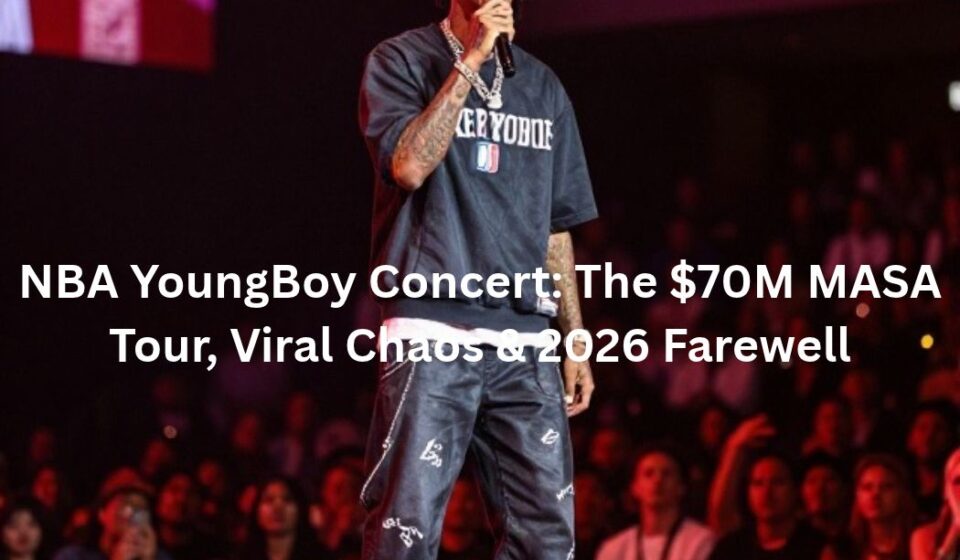
Imagine standing in a sold-out arena where 20,000 people are screaming every single word to a 40-song setlist, and the artist on stage has barely said a word to the crowd. There are no elaborate banter breaks, no political speeches, no costume changes. Just raw, relentless energy—and a sea of slime-green bandanas.
That was the reality of the NBA YoungBoy concert experience in 2025 and early 2026. While mainstream media often fixated on viral clips of chaotic crowds and canceled dates, something far more significant was happening inside the buildings: Kentrell Gaulden, the Baton Rouge native known as NBA YoungBoy, was quietly cementing his status as one of the most bankable and culturally potent live performers of his generation.
But as quickly as the MASA (Make America Slime Again) tour defined the live rap landscape, the story took a sharp turn. In August 2026, YoungBoy revealed he had relocated to South Korea, cited a serious heart condition, and declared he would only tour “one more time throughout my whole life” . This is the definitive look at the NBA YoungBoy concert phenomenon—the music, the mayhem, the economics, and the quiet, human reality behind the mask.
Background: From YouTube Prodigy to Arena Headliner
The Unconventional Rise
To understand the concert experience, you must first understand the artist. NBA YoungBoy didn’t follow the traditional music industry playbook. He built a fanatical following through sheer volume—releasing mixtapes at a pace that made his peers look lazy—and raw vulnerability. Songs like “Outside Today” and “Kacey Talk” weren’t radio hits engineered for pop crossover; they were diary entries from a troubled youth in Baton Rouge, delivered with a melodic whine that millions found deeply relatable.
By the time he announced the MASA tour in 2025, he had already achieved four No. 1 albums on the Billboard 200. However, the tour was a major test: could an artist who built his career on streaming and YouTube virality translate that into brick-and-mortar ticket sales? The answer, as we now know, was a resounding yes—with some serious caveats.
The Legal Cloud Lifts (Briefly)
The context of the 2025 tour cannot be separated from YoungBoy’s legal saga. After being sentenced to 23 months in federal prison on gun charges, he received a pardon from President Donald Trump in May 2025, which relieved him of remaining probation obligations. This newfound freedom was the catalyst for the MASA tour. For fans who had followed his legal battles for years, attending a concert wasn’t just entertainment; it was a collective celebration of his release and a defiant assertion of loyalty.
The Main Event: Inside the MASA Tour Experience
Record-Breaking Numbers and Cultural Impact
The statistics from the MASA tour are staggering. According to Touring Data, the 42-show run grossed over $70 million with more than 500,000 attendees, placing it on track to become one of the top 10 highest-grossing rap tours in American history. This wasn’t a niche underground tour; it was an arena-level juggernaut that filled venues like the Barclays Center, United Center, and Crypto.com Arena.
The stage design was theatrical and dark, often featuring a graveyard set, a dilapidated house, and dancers in ski masks. In a memorable entrance in Dallas, YoungBoy emerged from a suspended coffin, launching directly into the title track “MASA”. The production value was high, but the true spectacle was the crowd.
The Crowd: A Generational Phenomenon
Critics who attended the shows consistently noted that the audience was the real headliner. As observed in Houston and Dallas, the crowd didn’t just watch the performance; they performed it with him. Fan reactions were visceral. One reviewer compared the intensity to “20,000 of the most diehard Beyoncé fans, injected with Red Bulls,” noting that the noise level upon YoungBoy’s entrance was deafening.
The demographic was notably young. Teenagers and twenty-somethings, many of whom grew up with his music, treated the concert as a pilgrimage. They wore slime-green flags, recited every ad-lib, and created a wall of sound that often overpowered the arena’s PA system.
The Paradox of Minimalism
What stands out most about a YoungBoy concert is what doesn’t happen. He rarely speaks to the crowd beyond a brief “Let’s do it, man.” He doesn’t rely on a hype man to carry the energy. Instead, he delivers a rapid-fire setlist of nearly 50 songs, often performing only snippets or partial verses, seamlessly transitioning from one track to the next. This pacing reflects his streaming-era discography—fast, prolific, and relentless. For a casual observer, it might feel disjointed; for a diehard fan, it’s a high-speed highlight reel of their entire adolescence.
The Controversy: Separating Fact from Viral Fiction
The Media Narrative vs. On-the-Ground Reality
If you only consumed social media in the fall of 2025, you would believe that every NBA YoungBoy concert was a riot. Viral videos of kids fighting, rushing barriers, and disrespecting staff circulated widely, leading to sensational headlines. A skit by a popular comedian depicted security guards being brutalized, and a video from Kansas City showing a teenager assaulting an elderly arena employee went viral.
However, a deeper investigation reveals a more nuanced picture. Journalists who actually attended the shows and called police departments found that the vast majority of stops were peaceful. The New Orleans Police Department deployed over 400 officers for the final shows, anticipating trouble, but the event concluded with zero reported violent incidents. The Birmingham Police Chief even visited New Orleans to study their security tactics, and his city’s show also went off without a hitch.
The gap between the viral perception and the statistical reality is a classic case of confirmation bias. The “chaos” narrative fits a longstanding, often racially charged trope that associates rap concerts with violence. While isolated incidents did occur, the MASA tour was, by and large, a safe space for a marginalized youth demographic to release energy in a communal setting.
The Cancellations: A Deeper Story
Several shows, including dates in Chicago, Detroit, and a second Atlanta show, were canceled. While promoters cited security concerns, the cancellations also reflected the logistical difficulty of moving a massive, high-energy crowd through different municipal regulations and venue policies. The fact that fans in Atlanta gathered outside the canceled arena to sing his songs together without incident further underscores the community aspect of the fandom.
The 2026 Turning Point: A Farewell in Plain Sight
The Health Revelation
In August 2026, the narrative shifted from tour stats to human vulnerability. During an appearance on the Open Thoughts podcast, YoungBoy revealed that he had been diagnosed with a heart condition—specifically, swelling on the left side of his heart. He admitted that he had kept this secret during the entire MASA tour, continuing to perform grueling, high-energy shows despite the physical toll.
This confession reframes the entire concert experience. The intense, almost desperate energy of his performances—the pacing, the brevity of his speeches, the sheer endurance required to deliver 40 songs a night—takes on a new meaning when viewed through the lens of a young man battling a silent, potentially life-threatening ailment.
The Move to South Korea and the “Final Tour”
Simultaneously, YoungBoy confirmed he had relocated to South Korea and had no intentions of returning to the United States. Citing safety, cleanliness, and a desire to be “out the way,” he declared that he would only tour one more time before retiring from live performance.
This creates a fascinating paradox for the “NBA YoungBoy concert” in 2026 and beyond. His recent headline slot at the 2026 Rolling Loud festival in Orlando (May 8–10) may have been one of the last chances for American fans to see him. Any future tour will be framed not as a promotional cycle, but as a farewell—a victory lap for an artist who, despite his youth, is choosing to walk away from the machine while he still can.
Practical Tips for the (Possible) Final Tour
If YoungBoy announces that final tour, demand will be unprecedented. Here is how to navigate the experience based on the MASA tour learnings:
1. Ticket Strategy
-
Expect Dynamic Pricing: MASA tickets ranged from roughly $89 for upper level to $500+ for VIP. Given the “farewell” narrative, expect prices to surge. Do not wait for last-minute drops; the emotional stakes for fans will keep demand high.
-
Watch for Multi-Night Runs: He frequently played two nights in cities like Los Angeles, Atlanta, and New Orleans. If you miss the first night, a second date is often added due to demand.
2. What to Expect (and Not Expect)
-
Don’t Expect a Speech: YoungBoy communicates through music. He will not pause for five minutes to tell a story. The show is a sprint, not a marathon of banter.
-
Expect Snippets: Be prepared for a medley-style performance. If you are going specifically to hear the full three verses of a deep cut, you might be disappointed. The show is about momentum.
-
The Crowd is Part of the Show: Wear comfortable shoes. You will likely be standing and jumping for the entire 90 minutes. The energy is infectious, but it is also physically demanding.
3. Security and Safety
-
Arrive Early, Leave Late: Venues will have heightened security (as seen with the 400+ officers in New Orleans) . Bag checks will be thorough. If you are driving, be aware of your surroundings, especially in downtown areas after the show.
-
Respect the Space: The vast majority of fans are there for the music. Avoid the small pockets of chaos. If you see a fight brewing, move away. The community vibe is strong, but large crowds always require situational awareness.
Common Mistakes and Challenges
The Mistake: Judging the Experience by Viral Clips
The Solution: Social media algorithms reward conflict. If you base your decision to attend on a 15-second TikTok of a fight, you are missing the 99% of the concert where thousands of people are united in joy. Go with an open mind and focus on the stage, not the periphery.
The Mistake: Expecting a Traditional Rap Show
The Solution: YoungBoy is not a legacy act doing a greatest-hits revue with a live band. His set is a raw, DJ-driven sprint through his catalog. Embrace the chaos of the transitions and treat the show as a high-energy DJ set where the rapper is the instrument.
The Challenge: Navigating the “Last Chance” FOMO
The Solution: With the retirement announcement looming, fans may feel desperate to attend every show. Set a budget. The memory of one great night is better than the debt of three stressful ones. The music will live on long after the tour ends.
Pros, Cons, and Balanced Analysis
Pros
-
Unmatched Energy: The crowd engagement is arguably the best in live hip-hop right now. You will feel a part of something massive.
-
Value for Catalog: A 40+ song setlist means you hear almost everything you want, even if in snippet form.
-
Cultural Moment: Attending a YoungBoy show in this era is witnessing a specific chapter in rap history—the rise and retreat of a reclusive superstar.
Cons
-
Minimal Interaction: If you want to feel personally connected to the artist through stories or eye contact, this isn’t the show for you.
-
Inconsistency: The tour had cancellations. There is a risk that a date you plan to attend may be scrapped at the last minute.
-
Crowd Behavior (Isolated): While statistically safe, the presence of young, highly energized fans can be overwhelming for those who prefer a calmer concert environment.
Future Trends: What Comes After the Slime?
The Precedent of the “Streaming Giant” Tour
YoungBoy proved that an artist with a massive streaming footprint but limited radio play can sell out arenas. This will embolden other cult-favorite artists (like his collaborators NoCap and Offset, who opened the MASA dates) to book larger venues, bypassing traditional gatekeepers.
The Globalization of the Fanbase
With YoungBoy now residing in South Korea, a potential final tour might include international dates in Asia—a region where he has a growing, dedicated following. This could set a new standard for American rappers who feel disillusioned with the U.S. legal and political system, finding greener pastures (and safer streets) abroad.
The “Retirement” Economy
If YoungBoy truly tours only once more, expect a wave of nostalgia-driven marketing. Documentary crews will likely follow the final run. The tickets will be treated as collector’s items. The final show will be an emotional, star-studded event (likely in Baton Rouge or New Orleans). The “retirement tour” becomes a product in itself—a trend we are seeing across hip-hop as artists seek to control their legacies on their own terms.
Key Takeaways
-
The Numbers Don’t Lie: The MASA tour grossed $70M+ and proved YoungBoy is a top-tier arena draw, despite the media’s obsession with viral negativity.
-
The Experience is Raw: Expect a fast-paced, 40+ song setlist with minimal talking, explosive stage production, and a crowd that knows every word.
-
The Narrative is Skewed: While isolated incidents occurred, police data and on-the-ground reporting confirm the vast majority of shows were safe and peaceful.
-
The Future is Uncertain: YoungBoy has announced a move to South Korea and a likely end to touring due to a heart condition, making any future NBA YoungBoy concert a historic farewell.
Detailed FAQs
Q: Will NBA YoungBoy go on tour again in 2026 or 2027?
A: While he headlined Rolling Loud Orlando in May 2026, he has explicitly stated in August 2026 that he will only “go on tour one more time throughout my whole life”. No specific dates for a final tour have been announced as of this writing.
Q: Why were so many NBA YoungBoy concerts canceled?
A: The cancellations (Chicago, Detroit, second Atlanta) were a mix of security concerns raised by local authorities and logistical issues. However, many other cities (New Orleans, Dallas, Houston) hosted the shows without incident.
Q: Are NBA YoungBoy concerts dangerous?
A: Based on police reports and journalistic investigations, the actual violence rate was extremely low. The perception of danger was fueled by viral clips. If you attend, standard concert safety practices (staying aware, avoiding isolated areas) are sufficient.
Q: What songs does he typically perform?
A: The setlist draws heavily from his massive catalog, including hits like “Outside Today,” “Kacey Talk,” “Bandit,” “Make No Sense,” “Nevada,” and tracks from the MASA album.
Q: How long is the concert?
A: The main set runs approximately 90 minutes, but with openers (like NoCap and Offset), the entire event lasts around 3 to 3.5 hours.
Sources
This article is based on real-time reporting and reviews from the following sources:
-
Andscape: In-depth cultural analysis of the MASA tour, the media narrative vs. reality, and the Houston show experience.
-
Dallas Observer: Detailed review of the Dallas MASA tour stop, including tour gross data ($70M+) and stage design.
-
WBRZ (Louisiana): Local coverage of the New Orleans tour dates, security preparations (400+ officers), and ticket information.
-
The Lariat / atxconcert: First-hand student and fan reviews of the Las Vegas and Austin shows, detailing the setlist and crowd energy.
-
Concertful / Ticketmaster: Historical tour date data and venue information.
-
KLFY: Announcement of the 2026 Rolling Loud headline performance.
FOR FURTHER INFORMATION, VISIT: THELUXURYLIFEMAGAZINE.COM