
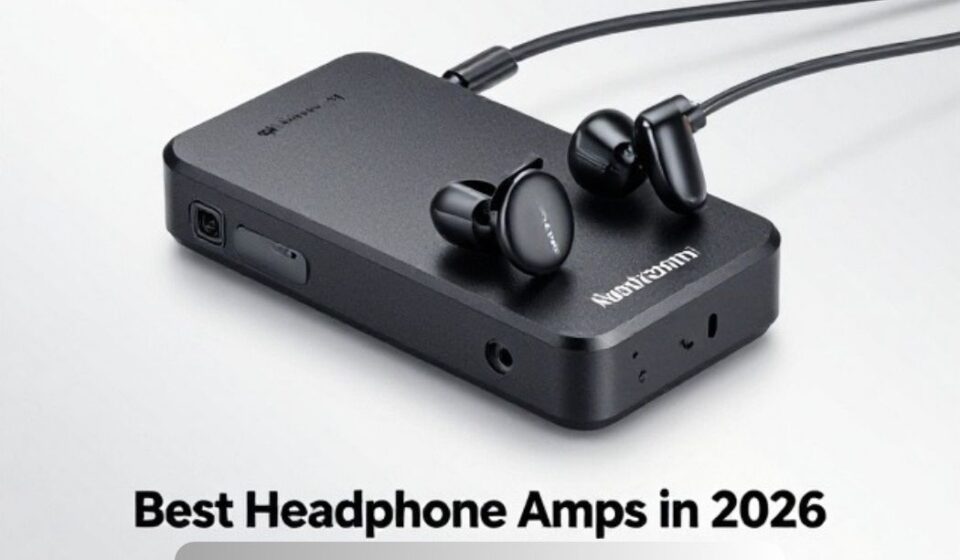
Best Headphone Amps: You just dropped serious cash on a pair of high-impedance dynamic headphones or planar magnetic monsters. You plug them into your laptop’s headphone jack, hit play, and feel… underwhelmed. The bass is flabby. The dynamics are squashed. The soundstage feels like a closet instead of a concert hall.
Here is the uncomfortable truth most audio brands won’t tell you: Your headphones are only as good as the amplifier feeding them. In 2026, the headphone amp market has never been more crowded—or more confusing. You have $79 dongles claiming to drive flagship planars, $3,000 tube monsters that double as space heaters, and a sea of Chinese desktop boxes with measurement specs that look like typo errors.
This guide cuts through the noise. We are going to look at what actually makes a headphone amp worth your money, which specific models punch above their weight in 2026, and the pairing mistakes that even seasoned hobbyists still make. Whether you are a beginner with a fresh pair of Sennheisers or a grizzled veteran chasing that last 5% of sonic bliss, there is a path here for you.
The Foundation: What a Headphone Amp Actually Does (And Why You Probably Need One)
Before we get to the gear, let us clear up a persistent myth. A headphone amplifier is not just a volume knob. Your phone or laptop has an amp inside it, sure—but it is built to a price point, optimized for battery life, and designed to drive the cheap earbuds that came in the box.
A dedicated headphone amp serves three critical functions:
-
Voltage Swing: High-impedance headphones (think 300-ohm Sennheisers) need voltage to reach loud volumes without clipping. A weak amp will make them sound thin and strained.
-
Current Delivery: Planar magnetic headphones (like those from HiFiMan or Dan Clark) are current-hungry beasts. They need an amp that can deliver quick bursts of power to reproduce dynamics without distortion.
-
Output Impedance Control: This is the spec nobody talks about at parties. A good amp has a low output impedance (ideally under 1 ohm) so it doesn’t alter the frequency response of your headphones. Plug a 32-ohm IEM into an amp with a 40-ohm output impedance, and you will get a muddy, bloated bass response that no EQ can fix.
The Analogy: Think of your headphones as a sports car. The DAC (Digital-to-Analog Converter) is the fuel. The amp is the engine. You can have the highest-octane fuel on the planet, but if the engine is a lawnmower motor, you are not going anywhere fast.
The 2026 Landscape: Three Tiers of Sanity
The market has stratified in a way that actually makes shopping easier, provided you know where to look. In 2026, you are essentially choosing between three approaches: the Portable Problem Solver, the Desktop Sweet Spot, and the Endgame Rabbit Hole.
Tier 1: The Portable Problem Solver ($50–$250)
If your primary listening happens on a laptop, phone, or while traveling, a portable DAC/amp dongle or a battery-powered unit is the move. These bypass your device’s internal audio circuitry entirely.
The iFi hip-dac3 remains a benchmark here. It is shaped like a flask (because of course it is), offers up to eight hours of battery life so it does not drain your phone, and includes both a 3.5mm single-ended and a 4.4mm balanced output. The balanced output is not just marketing—it often provides double the voltage for harder-to-drive headphones. Pairing it with something like the Meze 99 Classics or Dan Clark AEON 2 yields a noticeable tightening of the bass and improved imaging.
The Trend to Watch: The 4.4mm Pentaconn balanced connector is finally becoming the industry standard. If you are buying a portable amp in 2026 without a 4.4mm output, you are buying into a dying format.
Tier 2: The Desktop Sweet Spot ($150–$500)
This is where most enthusiasts should live. You get real power, proper analog volume knobs, and enough inputs to connect a DAC, a turntable, or a gaming console. The value proposition here has never been better.
The iFi ZEN CAN 3 is a fascinating case study in doing one thing well. It is only a headphone amplifier—no DAC inside. This is a feature, not a bug. If you already have a decent DAC (or plan to buy one separately), the ZEN CAN 3 offers a ridiculous amount of clean power for its size, plus iFi’s “XBass” and soundfield processing that can breathe life into lean-sounding headphones. It stacks perfectly with the matching ZEN DAC 3, creating a modular “build-your-own” system that you can upgrade piece by piece.
The Alternative: For the measurement-obsessed, the Schiit Magni line or the Topping L-series offer transparency and vanishingly low distortion for under $200. These are “wire with gain” amps—they do not add warmth or color. If your headphones are already perfectly tuned to your taste, this neutrality is ideal. If your headphones are bright or analytical, a clinical amp might make them sound harsh.
Tier 3: The Endgame Rabbit Hole ($500+)
Above $500, you are entering the realm of diminishing returns, but the returns are real—especially if you own flagship headphones that scale with better electronics.
The Tube Exception: The Schiit Valhalla 2 (around $349, technically just under our threshold) is a pure OTL (Output Transformerless) tube amp. It has a high output impedance (14 ohms), which means it is not suitable for planar magnetic headphones or sensitive IEMs. But with a 300-ohm Sennheiser HD 650 or HD 660S2? Magic. The tube harmonics add a lush, three-dimensional quality to vocals and strings that solid-state amps simply cannot replicate. The catch: you need high-impedance headphones to make it sing.
The Solid-State Flagship: At the top of the measurement mountain, amps like the Topping A90 or the Benchmark HPA4 offer distortion levels so low they are inaudible. The HPA4, with its THX-888 amplification stage, is essentially a laboratory instrument that happens to drive headphones. It will not add warmth or romance, but it will tell you the absolute truth about your recordings—for better or worse.
The Pairing Matrix: What Most Reviews Get Wrong
Here is the original framework I use for matching amps to headphones, and it is based on one often-ignored spec: Impedance Curves.
Most reviewers just say “this amp is warm” or “this amp is bright.” That is unhelpful. What actually matters is how the amp’s output impedance interacts with your headphone’s impedance curve.
| Headphone Type | What They Need | Amp Strategy | Example Pairing |
|---|---|---|---|
| High-Impedance Dynamics (HD 600/650/660S2) | High voltage swing; moderate current | OTL Tube or high-voltage solid-state | Schiit Valhalla 2 or Bottlehead Crack (DIY) |
| Low-Impedance Planars (HiFiMan Sundara, Dan Clark AEON) | High current; very low output impedance | High-current solid-state; avoid OTL tubes | Topping A90 or Lake People G111 |
| Sensitive IEMs (Campfire, Meze Rai) | Extremely low noise floor; fine gain control | Low-gain solid-state or portable dongle | iFi hip-dac3 on low gain |
| Hybrids (LCD-X, Focal Clear) | Versatility; slight warmth is welcome | Hybrid tube/solid-state or neutral solid-state | xDuoo TA-20 or iFi ZEN CAN 3 |
The Mistake to Avoid: Do not buy an OTL tube amp for planar magnetic headphones. Planars have a flat impedance curve (usually around 30–60 ohms). An OTL amp with a 40-ohm output impedance will act as a resistive divider, killing the bass response and collapsing the soundstage. I learned this the hard way with a Little Dot MKII and a HiFiMan Sundara—the result was anemic and lifeless. Save the tubes for your high-impedance dynamic cans.
The 2026 Trends Reshaping the Hobby
1. The “Separates” Renaissance
For years, the trend was all-in-one boxes. In 2026, we are seeing a swing back toward separates—dedicated DACs and dedicated amps. The iFi ZEN CAN 3 is a prime example: a pure amp with no digital inputs. Why? Because DAC technology ages quickly (new chips, new formats), but a good amplifier can last a decade. Buying a pure amp future-proofs your investment.
2. Balanced is the New Default
The 4.4mm Pentaconn connector has won. On portable gear, it is now standard. On desktop gear, 4-pin XLR and 4.4mm are increasingly common even on $200 amps. The benefit is real: balanced connections offer better channel separation and often double the voltage swing. Just remember: you need a balanced cable for your headphones to take advantage of it.
3. The “Measurement Wars” Have Peaked
The race to achieve the lowest THD+N (Total Harmonic Distortion + Noise) has largely plateaued. Any decent amp from a reputable brand in 2026 has distortion levels below the threshold of human hearing. The differentiator is no longer the spec sheet—it is the feature set, the build quality, and the sound signature (or lack thereof).
Practical Tips: How to Buy Without Regret
1. Calculate Your Power Needs (Seriously)
Do not guess. Use the formula: Power (mW) = 10^((Target SPL – Sensitivity) / 10). If your headphone has a sensitivity of 94 dB/mW and you want peaks of 110 dB SPL, you need 40 mW. Any amp delivering 250 mW gives you plenty of headroom. This prevents you from overspending on power you will never use.
2. The Return Policy is Your Best Friend
Audio is subjective. A highly regarded amp might sound sterile to you. A “warm” amp might sound muddy with your specific headphones. Buy from retailers with generous return policies (Crutchfield, Amazon, or specialized dealers). Give it a week. If it does not move you, send it back.
3. Do Not Neglect the DAC
An amplifier can only amplify what it is given. If you are feeding a $500 amp with a noisy laptop headphone jack, you are wasting money. A clean $100 DAC (like the Schiit Modi or iFi ZEN DAC) is a mandatory partner for any serious amp.
Common Mistakes (And How to Fix Them)
Mistake 1: Chasing Power for Power’s Sake
You see “6000mW” on a spec sheet and assume it is better. But power without gain control is useless. If an amp has a high noise floor on low gain, it will hiss with sensitive IEMs. Look for amps with selectable gain (low/medium/high) rather than just brute-force power.
Mistake 2: Ignoring the Volume Pot
A cheap potentiometer will have channel imbalance at low volumes—one ear will be louder than the other. This is infuriating with sensitive headphones. Look for amps with quality analog pots (ALPS RK27 is a good sign) or stepped attenuators.
Mistake 3: Buying a Tube Amp as Your First Amp
Tubes are fun. They are also finicky. They need warm-up time, they can pick up interference, and they require impedance matching. Start with solid-state. Learn what neutral sounds like. Then, if you want to experiment with tube flavor, buy a tube amp as a second purchase.
The Verdict: Pros, Cons, and the Honest Truth
The Pros of Investing in a Dedicated Amp:
-
Dynamic Headroom: Transients (drum hits, plucked strings) sound snappy and effortless instead of compressed.
-
Bass Control: The flabby, one-note bass from a laptop jack tightens into a defined, textured low-end.
-
Longevity: A good amp will outlast your headphones, your DAC, and probably your phone.
The Cons (and Honest Limitations):
-
Diminishing Returns are Steep: The jump from a laptop jack to a $200 amp is massive. The jump from a $200 amp to a $1000 amp is subtle—and only noticeable on resolving headphones in a quiet room.
-
The Rabbit Hole is Real: Once you hear what a good amp does, you will start wondering about a better DAC. Then better cables. It never ends.
Future Outlook: What’s Next for 2026 and Beyond
The headphone amp market is poised for a quiet revolution. As GaN (Gallium Nitride) power supplies become cheaper, we will see smaller, cooler, and more efficient desktop amps. We are also likely to see more DSP integration—onboard parametric EQ and room correction built directly into desktop amps, making the “source” and “amp” distinction even blurrier.
For the portable market, expect battery life to stretch further and dongles to become even more powerful, further eroding the need for a dedicated desktop setup for casual listeners. The future is modular, compact, and incredibly clean.
Key Takeaways (Quick Summary Box)
-
Match the Amp to the Headphone: OTL tubes for high-impedance dynamics (HD 650); high-current solid-state for planars (Sundara).
-
Power Matters, but Headroom Matters More: Aim for 200–500mW of clean power for most full-size headphones; ignore absurd 6W claims unless you own exotics.
-
The 4.4mm Balanced Standard is Here: Prioritize amps with a 4.4mm output for future compatibility.
-
The $200–$300 Sweet Spot: The iFi ZEN CAN 3 and Schiit Magni deliver 90% of the performance for 20% of the price.
-
Do Not Skimp on the DAC: A clean source is half the battle.
Detailed FAQs About Best Headphone Amps
Q: Do I need a headphone amp if I use IEMs?
A: Probably not for volume, but possibly for quality. Sensitive IEMs often pick up hiss from laptop jacks. A dedicated amp with a very low noise floor (like the iFi hip-dac3) will provide a blacker background and finer volume control.
Q: Can a headphone amp damage my headphones?
A: Only if you are reckless. It is actually more dangerous to under-power headphones (causing clipping) than to have too much clean power. Just start at low volume and turn up slowly.
Q: What is the difference between a DAC and an amp?
A: The DAC converts digital files (0s and 1s) into an analog electrical signal. The amp takes that signal and boosts its voltage and current to drive your headphones. Many devices combine both, but separates often offer better performance.
Q: Are tube amps worth it in 2026?
A: Yes, but for a specific flavor. Tube amps add harmonic distortion that many listeners find pleasing—warmth, body, and a sense of space. They are not “accurate,” but they are musical. Just make sure your headphones have the right impedance for the tube amp’s output.
Q: How much should I spend on my first amp?
A: If your headphones cost under $300, spend $100–$200 on an amp/DAC combo. If your headphones cost $300–$600, spend $200–$400. Beyond that, only upgrade if you are chasing a specific headphone that is known to be difficult to drive.
Sources: Best Headphone Amps
-
Crutchfield. “Best headphone amps for 2026.” (Product reviews and pairing notes for iFi hip-dac3 and ZEN CAN 3).
-
audio-stack.com. “Best Amps for the HD650 — A Pairing Guide.” (Technical breakdown of OTL vs. solid-state for 300-ohm headphones, March 2026).
-
hifiaudiosource.com. “Best Headphone Amps Under $300 2026.” (Analysis of power requirements and tube/planar impedance mismatches, May 2026).
-
iFi Audio. “How to Choose the Best DAC and Headphone Amplifier.” (Official guidance on gain structure and output impedance, 2025).
-
Stereophile. “Recommended Components 2026 Edition: Headphones.” (High-end tube amp and solid-state flagship context).
-
Speaker Ranking. “Best Headphone Amplifiers (October 2026).” (Measurement-based rankings and SINAD data).
-
NexReview. “Amp Reviews (2026) — Best Headphone Amps & DAC/Amp Combos.” (Budget tiering and common purchasing mistakes, August 2026).
FOR FURTHER INFORMATION, VISIT: THELUXURYLIFEMAGAZINE.COM