
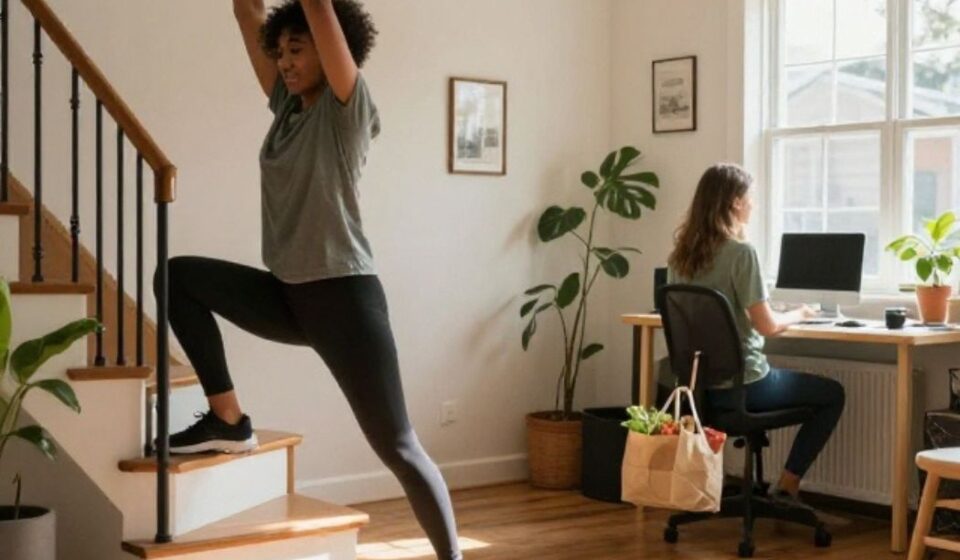
How to Stay Active: Here’s a number that should stop you mid-scroll: the average American worker now spends nearly 45% of the workday sitting—and if you’re a software developer, that figure skyrockets to 97.1%. We’ve engineered movement out of our lives with such precision that even our “leisure time” often involves a screen and a couch.
You already know you should stay active. You’ve heard the 150-minutes-per-week guideline more times than you can count. So why does it feel so hard?
Because most advice about staying active is built on a flawed premise: that movement is a task to be scheduled, not a state to be inhabited. In 2026, with hybrid work normalized and wearable tech ubiquitous, we have more tools and data than ever—yet global physical inactivity remains stubbornly high. The WHO estimates that if trends continue, 35% of adults will be insufficiently active by 2030.
This article isn’t another lecture. It’s a field guide to staying active in a world designed for stillness. We’ll dismantle the myths, examine what the latest research actually says works, and build a practical framework you can start using today—no gym membership required.
Background: Why “Staying Active” Became So Complicated
The Paradox of Modern Convenience
For most of human history, movement was non-negotiable. You walked to water, hunted for food, or labored in fields. Activity was woven into the fabric of survival. Today, survival requires almost no movement at all. Groceries arrive at your door. Meetings happen through a screen. Even banking and socializing are sedentary by default.
This isn’t a moral failing; it’s a design problem. Our environments have been optimized for efficiency, not for human biology. The result is a subtle but relentless erosion of daily movement that accumulates into what researchers call “sedentary time” —waking hours spent sitting or lying down with very low energy expenditure.
What the Guidelines Actually Say (and Where They Fall Short)
The WHO and CDC are clear: adults should aim for 150–300 minutes of moderate-intensity aerobic activity (or 75–150 minutes of vigorous activity) per week, plus muscle-strengthening exercises on at least two days. For older adults, balance training is added to the mix.
These guidelines are evidence-based and important. But they’ve created an unintended side effect: the “exercise binary.” We’ve come to believe that if we’re not doing a “workout,” we’re not being active. That mental model is both exhausting and counterproductive. A 2025 umbrella review in The Lancet Public Health found that workplace interventions focused solely on structured exercise often fail to meaningfully increase moderate-to-vigorous activity—while simpler, environment-based nudges show more promise.
The real insight? Staying active isn’t about adding exercise to your life. It’s about reducing the amount of time you spend completely still.
The Inactivity Epidemic: What’s Really Happening in 2026
The 1.8 Billion Problem
The numbers are stark. According to WHO data from 2022, approximately 1.8 billion adults—32% of the global population—did not meet recommended activity levels. The consequences are not abstract: physical inactivity is a leading contributor to cardiovascular disease, type 2 diabetes, and several cancers. The WHO estimates that between 2020 and 2030, nearly 500 million new cases of preventable noncommunicable diseases will occur due to inactivity, costing health systems over $300 billion.
The Desk Worker’s Dilemma
If you work in an office or from home, your environment is actively working against you. Office workers spend roughly 72.5% of their workday sitting. Standing desks help—they can reduce sitting time by 67–75 minutes per day—but here’s the catch: they don’t significantly increase moderate-to-vigorous activity. Swapping a chair for a standing desk is a net positive, but it’s not a substitute for actual movement.
This is what I call the “Stillness Trap” : feeling virtuous because you’re standing or wearing a fitness tracker, while your body still craves the deep, systemic benefits of genuine physical exertion.
The Mental Health Angle (That Most Articles Ignore)
We tend to frame activity in terms of weight and heart health. But the cognitive and mental health benefits are equally compelling—and arguably more immediately felt. Regular moderate activity improves executive function, attention, and mood. For knowledge workers, this isn’t a soft benefit; it’s a performance lever. A brisk 15-minute walk before a difficult task often does more for focus than another cup of coffee.
The Science of “Staying Active” vs. “Exercising”
The Movement Spectrum
Here’s a framework that most fitness content misses: activity exists on a spectrum, and each zone serves a different purpose.
| Zone | What It Looks Like | Primary Benefit |
|---|---|---|
| Baseline Movement | Walking to the store, taking stairs, cooking standing up | Metabolic health, circulation, reducing sedentary risk |
| Light Activity | Casual cycling, gentle yoga, gardening | Mobility, stress reduction, recovery |
| Moderate Activity | Brisk walking, dancing, easy swimming | Cardiovascular health, endurance, mood |
| Vigorous Activity | Running, HIIT, heavy lifting | Peak fitness, bone density, metabolic conditioning |
Most people oscillate between “baseline” and “vigorous”—a few workouts per week, then long stretches of stillness. The sweet spot for sustainable health is maximizing baseline movement while hitting moderate-to-vigorous targets a few times weekly.
The NEAT Advantage
NEAT (Non-Exercise Activity Thermogenesis) is the calories you burn through all the movement that isn’t formal exercise: fidgeting, walking, household chores, taking the stairs. For most people, NEAT varies by up to 2,000 calories per day depending on lifestyle. This is the hidden lever. You don’t need to run marathons to be “active”—you need to stop being completely still for most of your waking hours.
Practical Tips: How to Stay Active Without Overhauling Your Life
1. Anchor Movement to Existing Habits
Don’t create a new routine from scratch. Attach movement to things you already do:
-
After every bathroom break, do 10 squats or walk a lap around the office/house.
-
During phone calls, stand up and pace. This alone can add 30–60 minutes of light activity to a desk day.
-
While waiting for coffee or food to heat, stretch or do calf raises.
This is habit stacking in action, and it’s far more sustainable than a “gym at 6 AM” resolution.
2. Make Movement Social (and Therefore Sticky)
The Lancet review found that team-based challenges and social incentives outperform individual programs for increasing physical activity. Humans are social creatures. Use that:
-
Start a step challenge with colleagues or friends (pedometers plus psychological incentives increased daily steps by over 1,000 in research settings).
-
Schedule walking meetings for one-on-one conversations.
-
Join a recreational sports league—not for competition, but for the built-in accountability.
3. Embrace the “Micro-Workout”
You don’t need 45 uninterrupted minutes. Research supports breaking activity into smaller chunks throughout the day. A 10-minute walk after each meal is not only practical; it’s particularly effective for blood sugar management. Three 10-minute sessions equal one 30-minute session in terms of health benefits for many outcomes.
4. Use Technology as a Nudge, Not a Judge
Fitness trackers and smartwatches can be powerful tools—or sources of guilt and anxiety. The key is how you use them. A device that reminds you to stand up every hour is genuinely useful. A device that shames you for “closing your rings” is counterproductive.
In 2026, the best wearables for everyday activity are those that prioritize recovery and gentle nudges over aggressive gamification. If you use a tracker, set it to remind you to move, not to perform.
5. Reclaim the “Active Commute” (Even If You Work from Home)
If you commute, walk or cycle part of the way. If you work from home, create an artificial commute: a 10-minute walk around the block before you sit down at your desk, and another before you “clock out.” This serves double duty: it adds movement and creates a psychological boundary between work and home life.
6. Strength Train Twice a Week (The Non-Negotiable)
Aerobic activity gets the headlines, but muscle-strengthening exercises at least two days per week are a core part of every major guideline. Muscle mass declines with age, and strength training is the most effective intervention for maintaining bone density and metabolic health. You don’t need a gym: bodyweight squats, push-ups, lunges, and resistance bands can be done at home in 20 minutes.
Common Mistakes and How to Fix Them
Mistake #1: Going from zero to 100.
The most common failure mode is the “Monday reset”—deciding to work out every day, burning out by Wednesday, and quitting entirely. Fix: Start with a target so small it feels almost embarrassing. One 10-minute walk per day. One set of squats after brushing your teeth. Consistency beats intensity in the first month.
Mistake #2: Treating standing as the goal.
Standing desks are better than sitting, but standing still for hours creates its own problems (musculoskeletal strain, varicose veins). Fix: Alternate between sitting, standing, and moving. The goal is variety, not a static posture.
Mistake #3: Ignoring the “invisible” sitting.
You might not realize how much you sit during “active” days. A workout in the morning doesn’t cancel out 10 hours of sitting. Fix: Track your sitting time for one day—honestly. You’ll likely be surprised. Then set a timer to break it up every 45–60 minutes.
Mistake #4: Relying on willpower instead of environment.
Willpower is finite. If your environment makes movement inconvenient, you’ll eventually stop. Fix: Engineer your space. Put your walking shoes by the door. Keep a resistance band in your desk drawer. Make the active choice the easy choice.
Mistake #5: Forgetting recovery.
Activity without recovery leads to injury and burnout. Fix: Build rest days into your week. Sleep is when your body actually adapts to the stress of exercise. No amount of movement can compensate for chronic sleep deprivation.
Pros, Cons, and a Balanced View of the “Active Lifestyle”
The Pros:
-
Cardiovascular protection: Active adults can reduce their risk of death from cardiovascular disease by up to 35%.
-
Metabolic health: Movement improves insulin sensitivity and blood sugar regulation, even in short bursts.
-
Mental clarity and mood: The cognitive benefits of moderate activity are well-documented and often felt within minutes.
-
Longevity and independence: Strength and balance training in midlife are the best predictors of independence in later life.
The Cons (and Honest Limitations):
-
Time is a real constraint. For caregivers, shift workers, and people with chronic illness, “just move more” can feel dismissive. The WHO explicitly acknowledges that any activity is better than none, and that people with disabilities or chronic conditions should work within their abilities.
-
Progress is non-linear. Some weeks will be great; others will be a struggle. That’s normal.
-
The “active” identity can become rigid. If you define yourself as “an active person,” a missed workout can feel like a failure. A more resilient identity is: “I’m someone who moves throughout the day, in ways that fit my life.”
The Balanced Take: Staying active is not a moral obligation or a productivity hack. It’s a practice of honoring your body’s need for movement in a world that constantly asks you to be still. Some days will be 10,000 steps and a strength session. Other days will be a walk to the mailbox. Both count.
Future Trends: What’s Coming for Active Living (2026–2030)
1. The “Movement Snack” Goes Mainstream
Expect to see more workplaces and public spaces designed for micro-movement: walking paths between buildings, standing meeting rooms, and staircases that are actually pleasant to use. The WHO’s Global Action Plan targets a 15% reduction in physical inactivity by 2030, and policy momentum is shifting from individual behavior change to environmental redesign.
2. Wearables That Understand Recovery
The next generation of fitness tech is moving away from “more data” and toward smarter guidance. Devices that tell you when to rest rather than when to push harder are already emerging, and the market is rewarding them. The goal is sustainable activity, not exhaustion.
3. Hybrid Work’s Movement Dividend
Remote and hybrid work have a mixed record for activity. On one hand, the commute walk disappears. On the other, the flexibility allows for midday workouts or walking meetings that were impossible in a rigid office schedule. The organizations that thrive will be those that design hybrid work for movement, not against it.
4. The Rise of “Active Leisure”
As the fitness industry becomes more specialized and intimidating, expect a counter-trend: people rediscovering non-gym activity—hiking, dancing, recreational sports, gardening—as legitimate and sufficient forms of exercise. The best activity is the one you’ll actually do.
Key Takeaways
-
The 150-minute guideline is a floor, not a ceiling—and not the whole story. Your baseline movement throughout the day matters enormously for long-term health.
-
The “Stillness Trap” is real. Standing desks help, but they don’t replace actual movement. Break up sitting every 45–60 minutes.
-
Social and environmental strategies beat willpower. Team challenges, walking meetings, and visible cues (shoes by the door) are more effective than solitary resolve.
-
Strength training is non-negotiable. Two days per week, minimum. Bodyweight is enough.
-
Start embarrassingly small. A 10-minute walk is infinitely better than a 60-minute workout you skip.
-
Track movement, not performance. Use wearables for gentle nudges, not judgment.
FAQ: Your Questions About Staying Active, Answered
Q: I hate exercising. Can I still be healthy?
Yes. “Exercise” is a structured subset of activity. If you walk regularly, take the stairs, do household chores, and occasionally lift something heavy, you’re meeting many health guidelines. The best activity is the kind you don’t dread.
Q: How many steps per day do I actually need?
The “10,000 steps” figure was a marketing invention, not a scientific guideline. Research suggests that 7,000–8,000 steps per day is associated with significantly lower mortality risk for most adults, with diminishing returns beyond that. Even 4,000 steps is better than 2,000.
Q: Is it okay to break up exercise into tiny chunks?
Absolutely. The CDC explicitly recommends breaking activity into smaller segments throughout the day. Three 10-minute walks provide similar cardiovascular benefits to one 30-minute walk for many outcomes.
Q: What if I have a desk job and chronic pain?
Start with gentle movement and consult a healthcare professional. Walking, swimming, and gentle yoga are often accessible starting points. The key is finding a range of motion that doesn’t aggravate your condition—and building from there.
Q: How long does it take to form an “active habit”?
The “21 days” myth is just that—a myth. Research suggests habits take anywhere from 18 to 254 days to form, depending on complexity and context. Focus on consistency over speed. Missing one day won’t ruin you; missing two in a row is worth avoiding.
Q: Do I need a fitness tracker to stay active?
No. A tracker can be helpful for awareness and nudges, but it’s not necessary. If you have a phone, you have a step counter. If you have a timer, you can set movement reminders. The tool matters far less than the habit.
Sources and Further Reading
This article draws on guidelines and research from the following sources:
-
BMJ Global Health: Analysis of physical activity’s impact on noncommunicable disease mortality in the EU.
-
The Lancet Public Health (2025 umbrella review, via BeUpstanding): Workplace interventions for reducing sitting and increasing activity.
-
BMC Public Health: Scoping review on standing desks in university classrooms.
-
U.S. Bureau of Labor Statistics: 2025 data on occupational sitting time.
-
CDC and AHA/ACSM guidelines as summarized by HonorHealth Physicians.
-
Global Heart (2024): Physical inactivity and cardiovascular health.
-
NHS Lothian: 2026 summary of WHO physical activity guidelines.
FOR FURTHER INFORMATION, VISIT: THELUXURYLIFEMAGAZINE.COM