
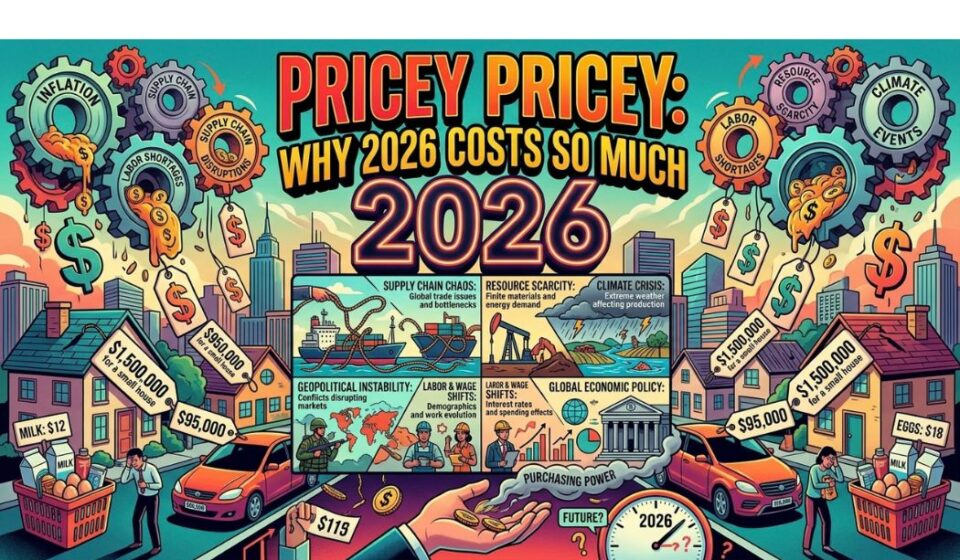
When was the last time you walked out of a grocery store and thought, “That felt reasonable”? If you’re like most Americans in 2026, that moment is a distant memory.
The numbers tell a brutal story. The average American household has had to spend more than **$3,500 extra** on everyday essentials since early 2025 — including roughly $310 more on groceries, $372 more on gas, $110 more on electricity, and $622 more on housing. In Wisconsin alone, families are paying over $3,300 more, with housing costs alone eating up $794 of that increase.
It’s not just one category. It’s everything. Concert tickets, fast food, clothing, insurance, childcare — the phrase “pricey pricey” has become less of a slang expression and more of a lifestyle description.
But here’s what most coverage gets wrong: this isn’t simply “inflation.” The forces driving prices in 2026 are a tangled web of geopolitics, trade policy, corporate pricing strategy, and a strange new consumer behavior called funflation. Understanding these forces — and knowing which ones you can actually do something about — is the difference between feeling helpless and feeling prepared.
This article breaks it all down. No jargon. No doom. Just clear analysis and practical moves you can make starting today.
Background: How We Got Here
To understand why 2026 feels so expensive, you have to rewind to 2025. That year, the U.S. implemented a sweeping set of new tariffs on imported goods. Initially, economists predicted an immediate price spike. But something strange happened: prices didn’t jump right away. Retailers absorbed costs, drew down existing inventory, and waited.
Then the delayed pass-through arrived.
By the first half of 2026, the Federal Reserve Bank of Minneapolis confirmed that “some of the worsening in core PCE inflation… was due to delayed tariff pass-through”. In plain English: the bill for 2025’s trade policy landed on 2026’s kitchen tables.
Meanwhile, geopolitical conflict in the Middle East disrupted oil shipments through the Strait of Hormuz — a chokepoint through which roughly 20% of the world’s oil flows. Energy costs surged, and transportation costs followed. Furniture, footwear, bananas, and chocolate — all heavily reliant on international supply chains — saw double-digit price increases.
By April 2026, CPI hit 3.8% year-over-year, the fastest pace since 2023. While inflation moderated somewhat by August (down to 3.4%), the cumulative effect of two years of elevated prices has permanently reshaped household budgets.
The result? A “cost of living crisis” that isn’t a crisis in the dramatic sense — no single catastrophe — but a grinding, persistent squeeze that has pushed consumer confidence to historic lows.
The Five Forces Making Everything Pricey Pricey
1. The Tariff Hangover
Tariffs are taxes on imports. And in 2026, American consumers are paying them — just not always visibly.
Between February 2025 and January 2026, American consumers paid more than $231 billion in tariff costs** — an average of roughly **$1,751 per family. Research from the National Bureau of Economic Research found that about 26% of the tariff increase passes directly through to consumer prices. The rest gets absorbed — or passed along through reduced product sizes, fewer discounts, and “shrinkflation.”
The effective tariff rate on imports peaked at 11% in late 2025 before falling to just below 7% by May 2026. But here’s the catch: prices rarely go down once they’ve gone up. Companies that raised prices to cover tariff costs have little incentive to reverse course when those costs ease.
What this means for you: Imported goods — electronics, furniture, clothing, certain foods — carry a “tariff premium” that may never fully disappear.
2. Energy Shocks and the Ripple Effect
Oil isn’t just gasoline. It’s plastic, fertilizer, shipping fuel, and synthetic fibers. When energy prices spike, everything downstream gets more expensive.
The war-driven disruption in the Middle East pushed U.S. gasoline prices above $4.50 per gallon by mid-2026. But the ripple effects went far beyond the pump. In Turkey and across the Middle East, vegetable and meat prices rose as transportation and agricultural input costs climbed.
In the U.S., electricity prices have skyrocketed 45% since 2019 — a trend that accelerated in 2026 as utilities passed on higher natural gas and grid maintenance costs.
3. Housing: The Silent Budget Killer
Housing costs don’t make headlines the way gas prices do, but they’re the single largest line item in most household budgets. And they’ve been climbing relentlessly.
Since 2020, home prices have increased 54% nationwide. In 2025, the median existing single-family sales price was nearly five times the median household income. Property taxes rose 31% between 2019 and 2025.
For renters, the picture is mixed. The national median asking rent in March 2026 was $1,669**, down 1.5% year-over-year — the 32nd consecutive month of annual declines for smaller units. But “declining” doesn’t mean “affordable.” A full-time worker now needs to earn **$34.73 per hour to afford a modest two-bedroom rental. That’s nearly $72,000 per year — well above the median individual income in many states.
4. Funflation: The Cost of Enjoying Life
Here’s where behavioral economics gets interesting. Despite the squeeze, Americans are still spending on the things they love — just paying more for them.
Economists call it “funflation” : the rising cost of leisure and entertainment. In August 2026, hobby spending jumped 7.9% year-over-year — more than double the 3.4% growth in transaction volume. Translation: people aren’t just doing more fun things; they’re paying significantly more for the same fun things.
Concert tickets, sporting events, amusement parks, streaming services, video games — all have seen above-average price increases. Even at-home entertainment got pricier as AI chip shortages drove up gaming console and component costs.
Why do consumers keep paying? Because experiences feel non-negotiable. You can skip the new jacket. You can downgrade your cereal brand. But telling your kid they can’t go to the amusement park? That’s a different conversation.
5. Corporate Pricing Power and “Greedflation” (Or Is It?)
A controversial but important factor: some companies are raising prices not because their costs went up, but because they can.
In early 2026, major brands including Levi’s, Chipotle, and Nike announced price increases — even as overall inflation cooled. The wealthy, meanwhile, remain “unfazed by inflation,” continuing to spend on “unapologetic luxury,” which economists note can “complicate the Fed’s ability to fight it”.
Is this greed? Opportunism? Or just smart business in a supply-constrained world? The honest answer is: it depends. Some price increases reflect real cost pressures. Others reflect a strategic decision to test what consumers will bear. Either way, the result for your wallet is the same.
The “Pricey Pricey” Reality Check: What It Actually Costs
Let’s put numbers to the feeling.
| Category | 2024 Cost | 2026 Cost | Change |
|---|---|---|---|
| Average grocery receipt | ~$49.70 | ~$66.13 | +33% |
| Gallon of gas | ~$3.50 | ~$4.50+ | +29% |
| Monthly electricity | Baseline | +$110/yr | +45% since 2019 |
| Two movie tickets + popcorn | ~$30 | ~$45+ | +50% |
| Manicure | ~$35 | $65+ | +86% |
Sources: JEC, BLS, USDA, industry reports
These aren’t abstract statistics. They’re the reason your grocery run feels like a financial event. The reason you think twice before ordering a cocktail. The reason “just staying in” no longer feels like a money-saving strategy.
Practical Tips: How to Fight Back Without Feeling Miserable
You can’t control tariffs or oil prices. But you can control how you respond. Here are strategies that actually work.
1. Audit Your “Funflation” Spending
Track your leisure spending for one month. Identify the top three categories. Then ask: “If this cost 20% more next year, would I still pay for it?” If yes, keep it. If no, start exploring alternatives now — before the next price hike forces your hand.
2. Master the “Price Per Unit” Game
Grocery stores are designed to confuse you. The bigger package isn’t always cheaper. Use your phone’s calculator (or a price-tracking app like Pricey, which shows real food prices reported by locals) to compare price per ounce, per gram, or per serving.
3. Lock In Fixed Costs Where You Can
Variable costs (gas, groceries) are hard to control. Fixed costs (rent, insurance, phone plans) are negotiable. Call your internet provider and ask for a retention offer. Shop your car insurance annually. If you’re renting, negotiate a longer lease in exchange for a rent freeze.
4. Embrace the “Hybrid Fun” Strategy
Funflation is real, but you can game it. Instead of a $150 concert ticket, host a themed watch party. Instead of a $65 manicure, learn basic nail care. Instead of a $30 fast-food run, invest in a $15 cast-iron skillet and learn three quick meals. The goal isn’t to eliminate fun — it’s to decouple fun from high spending.
5. Build a “Price Shock” Buffer
Every household should have a small fund — even $500 — specifically for price shocks. When your electric bill spikes or your car needs a repair, this buffer prevents you from putting it on a credit card and paying 24% interest on top of an already pricey purchase.
6. Buy Quality, Buy Once
When everything is expensive, cheap goods become expensive repeatedly. A $40 pair of boots that lasts six months costs more per wear than a $120 pair that lasts three years. This isn’t about being fancy — it’s about math.
Common Mistakes to Avoid
Mistake #1: Chasing “Deals” You Didn’t Need
A 40% off sale on something you wouldn’t have bought at full price isn’t a saving. It’s a spending trigger. The best deal is always the thing you don’t buy.
Mistake #2: Cutting All “Fun” Spending
Research on funflation suggests consumers who eliminate all discretionary spending eventually “revenge spend” — blowing their budget in one emotional purchase. Keep some fun. Just make it cheaper fun.
Mistake #3: Ignoring the Cumulative Effect
A $3 increase here, a $5 increase there — it doesn’t feel like much individually. But those small increases add up to thousands per year. Track your total spending, not just individual purchases.
Mistake #4: Blaming Yourself
If your budget feels tighter despite no major changes in your behavior, you’re not doing anything wrong. The system is genuinely more expensive. Give yourself grace, then make a plan.
Pros, Cons, and Balanced Analysis
The “Pros” of a Pricey Economy (Yes, There Are Some)
-
Innovation pressure: High prices incentivize companies to create more efficient, affordable alternatives — from budget grocery apps to secondhand marketplaces.
-
Waste reduction: When things cost more, people waste less. Food waste, fast fashion, and disposable culture all decline.
-
Local resilience: Expensive imports make local production more competitive, potentially strengthening regional economies over time.
The Cons
-
Inequality widens: Low- and moderate-income households feel price increases disproportionately. The Fed’s Beige Book noted that “increased reliance on food pantries” persisted through late 2025 and into 2026.
-
Mental load: Constantly optimizing spending is exhausting. Financial stress affects health, relationships, and productivity.
-
Economic drag: When consumers cut back, businesses earn less, which can lead to layoffs — a vicious cycle.
The Bottom Line: A pricey economy isn’t universally bad, but it is universally hard. The goal isn’t to pretend otherwise. It’s to navigate it with clear eyes and practical strategies.
Future Trends: What to Expect in 2027 and Beyond
Tariff Relief (Maybe)
If the Supreme Court rules against certain tariff structures, effective rates could fall to the mid-11% range on consumer goods. But don’t expect prices to drop proportionally. Companies rarely pass savings back to consumers without competitive pressure.
The “Creative Reset” in Luxury and Fashion
High-end brands are pivoting away from pure price hikes toward creative differentiation — using unconventional materials and storytelling to justify prices. This could trickle down to mid-tier brands, creating a more diverse pricing landscape.
AI-Driven Price Optimization
Retailers are increasingly using AI to adjust prices in real time based on demand, inventory, and even weather. This could mean more dynamic deals — but also more opportunities for you to be charged more when you’re most desperate.
The Secondhand Economy Accelerates
Gen Z is already driving a surge in vintage and resale purchases. As new luxury goods become harder to justify, the resale market will likely become the default for many categories.
Energy Transition as Price Stabilizer
As renewable energy capacity grows, long-term electricity price volatility may decrease. But the transition itself will have costs — expect a bumpy road before smoother pricing.
Key Takeaways: Your Pricey Pricey Survival Guide
-
The squeeze is real: Households are spending $3,500+ more per year on essentials.
-
The causes are systemic: Tariffs, energy shocks, housing shortages, and corporate pricing power — not individual failure.
-
Funflation is the new normal: Leisure costs are rising faster than overall inflation, and consumers are still paying.
-
You have more control than you think: Audit spending, lock in fixed costs, build a buffer, and prioritize value over volume.
-
The future is uncertain but not hopeless: Tariff relief, AI pricing, and the secondhand economy could all reshape the landscape in your favor.
Frequently Asked Questions (FAQs)
Q: Is “pricey pricey” an official economic term?
No. It’s colloquial slang for “very expensive.” But it captures the 2026 mood so well that economists and media have started using it informally.
Q: Will prices ever go back to 2020 levels?
Almost certainly not. Deflation is rare and economically dangerous. The goal isn’t to return to old prices — it’s to increase your income and adjust your spending so that current prices feel manageable.
Q: What’s the single biggest driver of high prices in 2026?
There’s no single driver. Tariffs, energy costs, housing shortages, and corporate pricing power all contribute. But energy costs have the widest ripple effect across the economy.
Q: How can I protect myself from funflation?
Set a monthly “fun budget” in cash. When the cash is gone, fun shifts to free or low-cost alternatives — parks, libraries, home cooking, game nights.
Q: Are tariffs going away?
Some may be reduced or struck down. But the political consensus around protecting domestic industries suggests tariffs — in some form — will remain a fixture of U.S. trade policy for years.
Q: What’s the best app for tracking real prices?
Apps like Pricey (for NYC food prices) and general tools like Flipp, Basket, and Honey can help. But the most effective tool is a simple spreadsheet where you log your top 10 recurring purchases and track them monthly.
Q: Is it better to rent or buy in 2026?
Renting is currently more affordable than buying in all 50 major U.S. metros. But “affordable” is relative. If you plan to stay in one place for 7+ years and have a stable income, buying can still make sense. Run the numbers for your specific situation.
Sources
-
U.S. Bureau of Labor Statistics, Consumer Price Index (August 2026)
-
Federal Reserve Bank of Minneapolis, tariff pass-through analysis (2026)
-
Joint Economic Committee, cost-of-living data (2026)
-
National Bureau of Economic Research, tariff pass-through study (2026)
-
Bank of America card data via CNBC, funflation reporting (2026)
-
Harvard Joint Center for Housing Studies, State of the Nation’s Housing (2026)
-
USDA Economic Research Service, Food Price Outlook (2026)
-
Federal Reserve Beige Book (February 2026)
FOR FURTHER INFORMATION, VISIT: THELUXURYLIFEMAGAZINE.COM