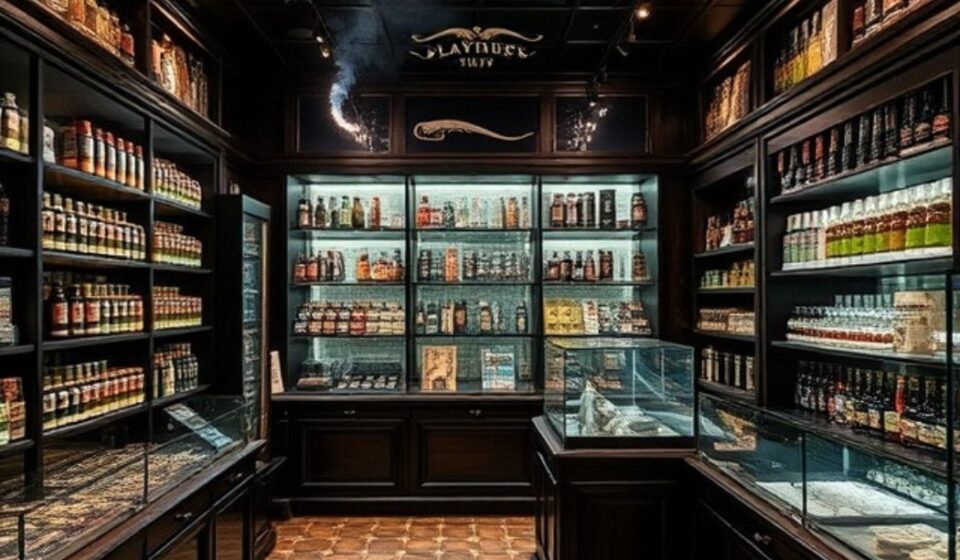
Walk into a typical smoke shop and you know what to expect: fluorescent lights, a glass counter crammed with pipes, the faint smell of stale incense, and a clerk who barely looks up from their phone. Now imagine the opposite. Plush seating. Curated glassware displayed like art. A humidor that rivals a high-end cigar lounge. Champagne on ice. Membership-only hours after 10 p.m.
This isn’t a fantasy. It’s the luxury life smoke shop — a rapidly growing retail category that’s rewriting the rules of how Americans buy smoking accessories. And in 2026, it’s not just a niche curiosity anymore. It’s a full-blown cultural shift.
The numbers tell a compelling story. The global smoking accessory market is experiencing significant transformation, driven by premiumization, technological innovation, and the mainstreaming of cannabis culture. In the U.S. alone, demand for premium experiences and lifestyle-branded accessories is reshaping what consumers expect from their local shop.
But here’s what most industry coverage misses: the luxury smoke shop isn’t just about selling expensive lighters. It’s about solving a problem that traditional head shops never addressed — creating a retail environment where successful professionals feel comfortable spending their money.
Let me show you what’s really happening, why it matters, and how to navigate this new landscape whether you’re a consumer, an aspiring entrepreneur, or just someone curious about where the culture is heading.
The Backstory: How We Got Here
From Head Shops to Lifestyle Boutiques
The traditional smoke shop has roots in counterculture. It was functional, often grungy, and deliberately outside the mainstream. That worked when smoking was either a vice or a subculture. But as cannabis legalization spread across states and nicotine alternatives like pouches gained massive traction, the customer base diversified dramatically.
Philip Morris International’s 2026 second-quarter results tell the story: the company surpassed $11 billion in net revenue, with smoke-free products now representing 42% of total group revenues. Zyn nicotine pouch shipments reached 2.9 billion units in the quarter. This isn’t a fringe market anymore. It’s Big Tobacco’s primary growth engine.
When that kind of money enters a category, retail expectations rise. Consumers who spend $8 on a can of Zyn or $300 on a premium vaporizer don’t want to buy it from a cluttered counter next to a bong shaped like a skull.
The Barneys Moment
The luxury smoke shop concept didn’t emerge overnight. A pivotal moment came in 2019 when Barneys New York opened “The High End,” a cannabis-focused shop-within-a-shop at its Beverly Hills flagship. The store featured limited-edition silver vape pens, leather ashtrays, gold rolling papers, and custom blown-glass pipes — all merchandised with the same care as designer handbags.
Barneys’ then-CEO Daniella Vitale explained the logic: “Many of our customers have made cannabis a part of their lifestyle, and The High End caters to their needs with extraordinary products and service they experience in every facet of Barneys New York”.
That experiment proved something crucial: there’s a market for premium smoking accessories when they’re presented with respect, not stigma.
The 2022-2026 Acceleration
The concept has since matured. Take Luxury Life Smoke Shop in Northridge, California — established in 2022 and open daily from 7 a.m. to midnight. It’s not just a place to buy products; it’s designed as a destination with trained staff and extended hours that accommodate professional schedules.
In Wichita, Kansas, UGB Billionaire Smoke Shop took the concept further: a “high-end luxury smoke shop” with a bar-style lounge offering champagne and wine, membership-only hours after 10 p.m., and a boutique convenience section featuring exotic snacks and drinks you can’t find anywhere else in the region.
The founders’ vision was explicit: “We’re really trying to change the culture and dynamic of smoke shops in our community” — to make it feel “like you’re in Atlanta or in Houston”.
That’s the key insight. The luxury smoke shop isn’t just selling products. It’s selling belonging.
The Legal Earthquake Reshaping Everything
The Federal Hemp Crackdown of 2026
You cannot understand the luxury smoke shop landscape in 2026 without grappling with the regulatory tsunami that’s about to hit.
In November 2025, Congress passed and President Trump signed the Continuing Appropriations and Extensions Act, 2026. Tucked inside was a sweeping revision of federal hemp law that closes what lawmakers called the “hemp loophole”.
Here’s what changes on November 12, 2026:
-
Hemp is redefined to include total THC (including THCA) at no more than 0.3% on a dry-weight basis — not just delta-9 THC.
-
Synthetic cannabinoids are excluded from the definition of hemp entirely. This includes delta-8 THC and similar isomer products created through chemical conversion of CBD.
-
Final hemp-derived products must contain no more than 0.4 milligrams of total THC per container.
The practical effect is enormous. Products that have flooded smoke shops across the country — delta-8 gummies, THCA flower, high-potency hemp vapes — will fall outside federal hemp protection.
What This Means for Smoke Shops
For luxury smoke shops, the regulatory shift creates both a crisis and an opportunity.
The crisis is obvious: many shops have built significant revenue on hemp-derived products. Those products are now facing a compliance cliff. Oklahoma’s Department of Agriculture issued a clarification letter in January 2026 explicitly stating that “delta-8 and similar isomer products” are excluded from the federal hemp definition and cannot be marketed as hemp after November 12.
The opportunity is subtler. As low-quality, high-potency hemp products get squeezed out, the market for premium, compliant, beautifully presented alternatives expands. Luxury shops that have already positioned themselves around curation, education, and experience are better prepared than discount competitors.
The State-by-State Patchwork
Adding to the complexity, state laws vary wildly. As of mid-2026:
-
Some states treat hemp-derived THC like cannabis (heavily restricted or illegal outside licensed dispensaries).
-
Others permit it with caps on milligrams per serving and per package.
-
A few, like Texas, have banned delta-8 and similar compounds while permitting hemp delta-9 edibles under specific conditions.
The road trip trap is real. A delta-8 vape legally purchased in Missouri becomes a Schedule I narcotic the moment you cross into Kansas, which added delta-8 to its controlled substances schedule in early 2026.
For luxury smoke shop owners, this patchwork means compliance is now a core competency. The shops that thrive will be those that treat regulatory literacy as seriously as they treat interior design.
What Actually Makes a Smoke Shop “Luxury”?
Beyond the Aesthetic
Let’s be honest: “luxury” gets thrown around loosely in retail. A velvet rope and a neon sign don’t make a space premium. So what separates a genuinely luxury smoke shop from a pretender?
Based on how the category is evolving, here are the defining characteristics:
1. Curated Product Selection, Not Overwhelming Inventory
Traditional smoke shops compete on volume. Luxury shops compete on taste. That means fewer SKUs, each one vetted for quality, design, and story. Think artisan glass from recognized makers rather than mass-produced imports. Premium lighters from heritage brands. Accessories that work as objects of desire, not just tools.
2. Environment as Experience
The luxury shop is designed to be lingered in. Comfortable seating. Good lighting. Music that doesn’t assault the senses. In Wichita’s UGB Billionaire Smoke Shop, the lounge concept includes champagne and wine service — explicitly mimicking the hospitality model of a high-end bar rather than a retail store.
3. Service That Educates Rather Than Sells
Staff at luxury shops are trained to guide, not upsell. That means product knowledge that goes deep: understanding terpenes, extraction methods, device mechanics, and legal compliance. It means asking questions before making recommendations.
4. Membership and Community
The membership model is emerging as a key differentiator. UGB Billionaire restricts entry after 10 p.m. to members only, framing it as both a safety measure and a perk. This creates exclusivity while building a repeat customer base.
5. Extended Hours and Accessibility
Luxury doesn’t mean inconvenient. The Northridge Luxury Life Smoke Shop operates from 7 a.m. to midnight daily. That’s designed around professional schedules — early risers and late-night wind-downs alike.
The Ashtray Principle
Here’s a fascinating signal of where the luxury smoking market is heading: designer ashtrays are becoming serious collectibles.
A 2026 report from the Italian market noted that ashtrays from brands like Venini, Hermès, and Fornasetti are appreciating at auction. Pieces by G.P. Grant in gemstones and lapis lazuli have exceeded €60,000. A set from the Four Seasons Restaurant in New York sold for nearly $13,000.
Why does this matter for smoke shops? Because it signals that smoking accessories are being re-evaluated as design objects, not disposable commodities. The luxury smoke shop of 2026 and beyond will increasingly function as a gallery as much as a retail store — a place where connoisseurship is celebrated and objects are presented with museum-level care.
The Consumer’s Guide to Navigating Luxury Smoke Shops
What You Should Expect to Pay
Luxury smoke shops operate on different economics than traditional head shops. Here’s a rough framework:
| Category | Traditional Shop | Luxury Smoke Shop |
|---|---|---|
| Glass pipe | $15–$40 | $75–$500+ |
| Vaporizer | $30–$80 | $150–$400 |
| Lighter | $2–$10 | $50–$300 |
| Accessories | $5–$20 | $25–$150 |
The premium isn’t arbitrary. It reflects material quality, design, brand heritage, and the experience of the retail environment itself.
How to Evaluate Whether a “Luxury” Shop Deserves Your Money
Not every shop that calls itself luxury is worth the markup. Here’s what to look for:
-
Staff knowledge: Can they explain the difference between borosilicate and soft glass? Do they know the extraction method behind a product? If they can’t answer basic questions, walk out.
-
Product transparency: Luxury shops should have no problem showing you COAs (Certificates of Analysis) for any hemp-derived product. If they dodge the question, that’s a red flag.
-
Compliance awareness: With the November 2026 federal changes looming, a responsible shop should be actively adjusting inventory. Ask how they’re preparing.
-
Environment: Does the space feel intentional? Is the lighting flattering? Is the seating comfortable? Luxury is in the details.
-
Return policies: Premium retail stands behind its products. A no-returns policy on a $300 vaporizer is not luxury — it’s risk transfer.
The Membership Question
Some luxury shops are moving toward membership models. Before you pay for access, ask yourself:
-
How often do you actually visit?
-
What concrete benefits does membership provide (discounts, early access, event invitations)?
-
Is the shop’s location convenient enough to justify the commitment?
Membership works best for enthusiasts who treat the shop as a regular destination, not occasional visitors.
Common Mistakes and How to Avoid Them
Mistake #1: Assuming “Luxury” Means “Legal”
This is the biggest trap in 2026. A beautifully designed shop selling delta-8 products may be operating in a legal gray zone — or outright violation — depending on the state and the looming federal deadline.
Solution: Before purchasing any hemp-derived product, verify your state’s current status. As of mid-2026, states like California, Alaska, and Utah have heavily restricted or illegal status for many hemp THC products, while others remain permissive. The situation is changing fast.
Mistake #2: Overpaying for Branding, Not Quality
Some shops slap a premium price on generic products and call it luxury. The markups don’t always reflect superior materials or craftsmanship.
Solution: Research brands independently. Look for names with verifiable reputations — companies like GRAV Labs, PAX Labs, Roor, and Santa Cruz Shredder appear on industry reports as significant market players. A luxury shop should carry at least some recognized premium brands, not just house-labeled generics.
Mistake #3: Ignoring the Regulatory Calendar
November 12, 2026 is a hard deadline for federal hemp product compliance. Products that don’t meet the new standards will be federally illegal.
Solution: If you’re a consumer who relies on hemp-derived products, start transitioning now. If you’re a shop owner, don’t wait until October to clear non-compliant inventory. The smart operators are already pivoting.
Mistake #4: Confusing Atmosphere with Substance
A shop can have velvet chairs and still give you terrible advice. The experience should enhance the transaction, not replace it.
Solution: Judge a shop by the questions its staff asks, not the furniture they sit on. Good service means understanding your needs before recommending a product.
The Balanced View: Pros, Cons, and Who This Is Really For
The Upside
-
Elevated experience: Shopping for smoking accessories doesn’t have to feel transactional or stigmatized.
-
Better curation: Less junk, more intentional selection.
-
Education: Staff who know their products can help you make better choices.
-
Community: Membership models and lounges create social connection.
-
Investment potential: Premium accessories — particularly designer glass and collectible ashtrays — can appreciate in value.
The Downside
-
Higher prices: You pay for the environment and curation, not just the product.
-
Regulatory risk: The hemp product landscape is shifting dramatically, and even well-run shops face compliance uncertainty.
-
Limited accessibility: Luxury shops tend to cluster in affluent areas, leaving gaps elsewhere.
-
Potential for pretension: Not every “luxury” shop delivers on its promises.
Who Thrives Here
The luxury smoke shop model works best for:
-
Professionals who value discretion and want a retail experience that fits their lifestyle.
-
Connoisseurs who appreciate craftsmanship and are willing to pay for quality.
-
Social smokers who see the shop as a destination, not just a pit stop.
-
Collectors interested in limited-edition glass, designer accessories, and investment-grade pieces.
If you’re looking for the cheapest possible grinder, this isn’t your category. And that’s fine — different shops serve different needs.
Where This Is Heading: Predictions for 2027 and Beyond
1. The Great Hemp Shakeout
The November 2026 federal deadline will trigger a significant contraction in the hemp-derived product market. Shops that built their business on delta-8 and high-THCA products will either pivot or close. Survivors will be those with diversified product mixes — premium glass, nicotine alternatives, cigars, and compliant wellness products.
2. Nicotine Pouches Become a Luxury Category
Zyn and similar products are already driving Big Tobacco’s growth. Expect luxury shops to lean harder into this category, with curated pouch selections, premium storage accessories, and possibly even tasting bars — similar to how coffee shops treat espresso.
3. Lounge Culture Expands
The Wichita model — smoke shop plus bar-style lounge with membership hours — is likely to spread. It solves multiple problems: it creates recurring revenue, builds community, and differentiates the shop from online competitors.
4. Design-Forward Accessories Go Mainstream
The collectible ashtray trend signals a broader shift. Expect more collaborations between smoking accessory brands and established designers. Limited-edition drops. Auction-house partnerships. The smoke shop as gallery becomes less metaphor, more reality.
5. Regulatory Patchwork Gets More Complex
Even with federal hemp changes, state-level variation will persist and likely intensify. Some states will move to fold hemp products into their cannabis regulatory systems. Others will ban them outright. Luxury shops will need sophisticated compliance operations — or specialized legal counsel on retainer.
Key Takeaways
-
Luxury life smoke shops are a real, growing category — not just head shops with better furniture, but a fundamental rethinking of the retail experience for smoking accessories.
-
The federal hemp crackdown of November 2026 is the single biggest regulatory event in the category’s history. Delta-8 and similar synthetic cannabinoids will fall outside federal hemp protection.
-
Luxury means curation, service, and environment — not just high prices. Evaluate shops by staff knowledge, product transparency, and compliance awareness.
-
The consumer base has diversified beyond counterculture stereotypes. Professionals, connoisseurs, and collectors are driving demand for premium experiences.
-
Membership and lounge models are emerging as key differentiators, creating recurring revenue and community.
-
Designer accessories are appreciating assets — ashtrays from heritage brands are selling at auction for thousands of dollars.
-
Compliance is now a competitive advantage. Shops that treat regulatory literacy seriously will survive the shakeout.
-
The road trip trap is real: Don’t carry THC products across state lines, even if they’re legal where you bought them.
Frequently Asked Questions
What exactly is a luxury life smoke shop?
A luxury life smoke shop is a retail concept that applies premium hospitality standards to the sale of smoking accessories and related products. Key features typically include curated product selection, comfortable lounge seating, knowledgeable staff, extended hours, and sometimes membership models or beverage service. The goal is to create an experience that feels closer to a boutique hotel lobby than a traditional head shop.
Are delta-8 products still legal in 2026?
It depends entirely on your state and the specific product. Federally, the November 2026 changes will exclude delta-8 from the definition of hemp, effectively making it a controlled substance outside of state-licensed cannabis channels. Some states have already banned it. Others permit it with restrictions. The situation is changing rapidly, so verify current law before purchasing or traveling.
What happens on November 12, 2026?
The federal hemp definition changes take effect. After this date, hemp-derived products must contain no more than 0.4 milligrams of total THC (including THCA) per container. Synthetic cannabinoids like delta-8 are excluded from the hemp definition entirely. Products that don’t comply fall outside federal hemp protection and may be treated as controlled substances.
Can I buy luxury smoking accessories online?
Yes, but the experience differs from in-person shopping. E-commerce is expanding rapidly in this category, driven by consumer demand for convenience and discretion. However, for high-value items like artisan glass or precision vaporizers, in-person inspection is often worth the effort. Many luxury shops also offer online ordering with in-store pickup.
Are expensive lighters and accessories actually worth it?
It depends on what you value. A $200 lighter doesn’t light things 100 times better than a $2 one. But premium accessories offer better materials, superior craftsmanship, longer lifespan, and often appreciate in value. The collectible ashtray market demonstrates that well-made smoking accessories can be genuine investments. If you appreciate design and durability, the premium can be justified. If you just need flame, it can’t.
How do I find a legitimate luxury smoke shop in my area?
Look for shops that prioritize education over upselling. Check whether staff can answer detailed questions about product sourcing, materials, and compliance. Read reviews that focus on service quality, not just selection. Visit during off-peak hours and observe how the space feels. A genuine luxury shop invests in atmosphere and expertise, not just inventory.
What’s the future of smoke shops post-2026?
The category is bifurcating. Discount shops competing on price and volume will face increasing pressure from regulation and online competition. Luxury shops that compete on experience, curation, and community will likely thrive — particularly if they diversify beyond any single product category and build membership or loyalty models. The smoke shop as destination, not just transaction point, is the emerging model.
Sources
-
Yelp listing for Luxury Life Smoke Shop, Northridge, CA — business details and hours
-
Oklahoma Department of Agriculture, Food, and Forestry, Hemp Clarification Letter, January 2026
-
Tobacco Reporter, “Smoke-Free Gains Push PMI Over $11B in Q2,” July 2026
-
Research and Markets, Smoking Accessory Market Global Strategic Business Report
-
Cannabis Regulations AI, “Are Edibles Legal? The 2026 State-by-State Guide,” September 2026
-
DLA Piper, “New federal restrictions on hemp and hemp-derived products,” November 2025
-
Moneta, “No smoking, please. Arde la passione per i posacenere dei grandi designer,” March 2026
-
Luxury Daily, “Barneys’ upcoming High End concept shop exhibits cannabis’ prolific nature,” February 2019
-
VICE, “Where Is THC Legal? See the 2026 State-by-State Map,” June 2026
-
DLA Piper, Food and Beverage News and Trends, November 2025
-
Wichita Eagle, “A new lounge is coming to Old Town in Wichita,” September 2021
-
AllowedHere, “The 2026 Road Trip Trap,” April 2026
-
Minnesota Office of Cannabis Management, “Federal Hemp Changes,” August 2026
-
Retail News Asia, “Philip Morris Tops $11 Billion in Net Revenue,” September 2026
-
Research and Markets, Smoking Accessory Market in United States