
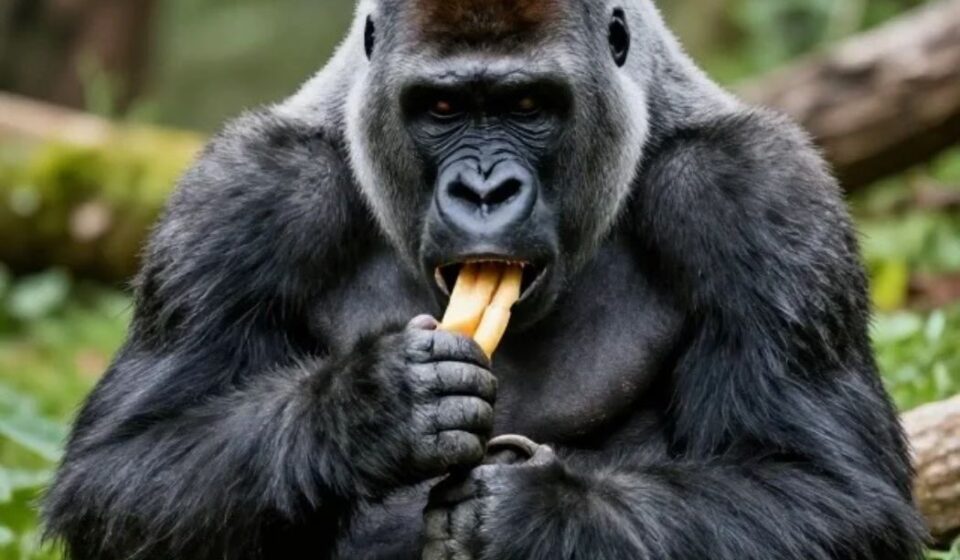
Picture a gorilla. What comes to mind? A massive silverback chomping on a handful of leaves, perhaps, or a gentle giant peeling a bamboo shoot while its infant tumbles nearby. For most of us, the gorilla is the ultimate herbivore—a peaceful, plant-powered primate that wouldn’t hurt a fly.
But here’s a question that has quietly nagged primatologists for decades: do gorillas eat meat?
The answer, as with most things in biology, is delightfully messy. It’s not a simple yes or no. It’s a story about feces samples, ant digestive tracts, and the occasional opportunistic snack that challenges everything we thought we knew about our second-closest living relatives. If you’ve ever wondered whether these forest giants are truly strict vegetarians—or whether there’s a carnivorous secret hiding behind those gentle brown eyes—you’re in the right place.
In this article, we’ll dig into the science, separate fact from fiction, and explore why this seemingly niche question has real implications for gorilla conservation, captive care, and our understanding of primate evolution. Let’s peel back the leaves.
Background: What We Thought We Knew
The Classic View: Gorillas as Herbivores
For most of scientific history, gorillas have been classified as herbivores—specifically, folivores and frugivores. Their diet is overwhelmingly plant-based: leaves, shoots, stems, bark, roots, fruits, and the occasional handful of insects. Mountain gorillas, which live at high altitudes where fruit is scarce, subsist almost entirely on herbaceous vegetation. In the Virunga Volcanoes, for instance, fruit makes up less than 1% of their diet. Western lowland gorillas, by contrast, enjoy a more varied menu—fruit can constitute about 35% of their intake, alongside leaves, nuts, and insects.
Their anatomy reflects this plant-powered lifestyle. Gorillas possess a large colon and cecum packed with cellulose-digesting ciliates, a hallmark of herbivorous digestion. Their teeth—those massive molars and formidable canines—are built for crushing fibrous plant material, not slicing flesh. As one 19th-century explorer bluntly put it after examining gorilla stomachs: “The gorilla… is a strict vegetarian”.
The Cracks in the Story
But nature rarely respects our neat categories. In 2010, a study published in the journal PLOS ONE sent a ripple through the primatology world. Researchers analyzing feces from wild western lowland gorillas in Loango National Park, Gabon, detected DNA from monkeys and small forest antelopes called duikers. The finding raised an uncomfortable possibility: were these supposedly vegetarian apes secretly eating meat?
The study’s own authors urged caution. There were plenty of alternative explanations—gorillas might have eaten ants that had scavenged mammal carcasses, or the DNA could have contaminated the feces after deposition. As co-author Grit Schubert told National Geographic, “I don’t really think they’re eating meat”.
Yet the question lingered. And it’s worth asking: what does the current evidence actually say?
The In-Depth Science: Do Gorillas Eat Meat?
The Direct Evidence: Rare, Opportunistic, and Small-Scale
Let’s be clear from the outset: there is no robust evidence that wild gorillas actively hunt and consume large mammals as part of their regular diet. Unlike chimpanzees, their fellow great apes, gorillas have never been observed engaging in coordinated hunting behavior. Chimpanzees famously hunt colobus monkeys, and meat can make up a meaningful portion of their caloric intake in some populations. Gorillas? Not so much.
However, wild gorillas do consume animal matter—just not in the form you might expect. Mountain gorillas have been documented eating snails, ants, worms, and larvae, which provide valuable protein and calories in their high-altitude environment. This is technically “meat” in the broadest sense—animal tissue—but it’s a far cry from predation on mammals.
The occasional larger animal may also end up on the menu, albeit accidentally or opportunistically. The Loango feces study remains the most tantalizing hint, but subsequent research has not confirmed active meat-eating. The scientific consensus as of 2026 is that gorillas are best described as herbivores with omnivorous tendencies—opportunistic consumers of invertebrates and, very rarely, vertebrate tissue, but not predators in any meaningful sense.
The Zoo Factor: Captive Gorillas and Dietary Flexibility
Here’s where things get interesting. Captive gorillas have been known to eat meat when it’s offered. This shouldn’t surprise us. Most herbivores can digest meat quite well—it’s the reverse that’s problematic. As geneticist Michael Hofreiter noted, “Most herbivores can digest meat quite well. It just does not work the other way around”.
This tells us something important: gorillas aren’t physiologically incapable of processing meat. Their digestive systems are flexible enough to handle animal protein. The reason they don’t eat more of it in the wild isn’t a lack of ability—it’s a lack of necessity and opportunity. Leaves don’t run away.
Why the Confusion? The Ants and the Feces
The Loango study’s findings are a perfect case study in scientific caution. The researchers found mammal DNA in gorilla feces, but the most parsimonious explanation wasn’t predation. Gorillas eat ants. Those ants scavenge carcasses. When a gorilla eats an ant, it also ingests whatever is in the ant’s digestive tract—including trace mammal DNA.
Alternatively, monkeys or duikers might have sniffed, licked, or even urinated on gorilla feces after it was deposited, contaminating the sample. Science is rarely as clean as we’d like.
The Nutritional Logic: Why Meat Isn’t a Priority
Gorillas are enormous. An adult male can weigh over 200 kilograms (440 pounds). To fuel that bulk, they need calories—and lots of them. Mountain gorillas spend at least a quarter of their waking hours eating and can consume up to 34 kilograms (75 pounds) of vegetation per day.
Plant matter is abundant in their habitats. It doesn’t fight back. It doesn’t require pursuit. For a large, slow-moving primate that relies on fermentation in its gut to extract energy from fiber, chasing down prey would be a spectacularly inefficient use of time and energy. The evolutionary calculus simply doesn’t favor predation for gorillas in the way it does for chimpanzees, which are smaller, faster, and more omnivorous.
That said, gorillas do seek out protein-rich plant foods when available, and their consumption of insects and other invertebrates suggests a subtle nutritional balancing act. They aren’t strict vegans by choice—they’re plant-based by ecology.
Practical Implications: What This Means for Conservation and Captive Care
For Conservationists
Understanding gorilla diets is about more than curiosity. Habitat loss and climate change are altering the availability of key plant foods. If gorillas are more nutritionally flexible than we thought—able to exploit animal matter when plants are scarce—that could slightly buffer them against food insecurity. But let’s not overstate it: gorillas cannot survive on meat. Their populations depend on intact forests with diverse plant life.
More importantly, the meat question intersects with a darker issue: the bushmeat trade. Gorillas are sometimes killed for their meat, particularly in parts of Central and West Africa where ape meat is considered a luxury item. This is not subsistence hunting—it’s a commercial threat that compounds the pressures of habitat loss and disease. Every gorilla lost to the bushmeat trade is a blow to already fragile populations.
For Zoos and Sanctuaries
Captive gorillas are typically fed a carefully formulated vegetarian diet—vegetables, fruits, leafy greens, and fiber-rich pellets. The knowledge that they can digest meat doesn’t mean they should be fed it regularly. Their gut microbiome is adapted to plant fermentation, and abrupt dietary shifts can cause serious digestive distress. The occasional insect or invertebrate is fine; a steak is not.
For Budding Primatologists
If you’re fascinated by gorilla behavior, remember this: the absence of evidence isn’t evidence of absence. The Loango study showed us that wild gorillas may surprise us yet. But it also showed us the importance of rigorous methodology. Before we rewrite the textbooks, we need more than a few contaminated feces samples. We need direct observation, controlled studies, and replication.
Common Mistakes and Challenges
Mistake #1: Confusing “Omnivore” With “Predator”
Some sources label gorillas as “omnivores” because they eat insects. Technically true, but misleading. An omnivore in the ecological sense eats both plants and animals. A gorilla’s animal intake is minuscule—a few ants, a snail, perhaps some larvae. Calling a gorilla a predator is like calling a rabbit a carnivore because it accidentally swallows a bug.
Mistake #2: Over-Interpreting the Loango Study
The 2010 feces study is frequently cited as “proof” that gorillas eat monkeys. It isn’t. The authors themselves were skeptical. Good science requires ruling out alternative explanations, and the contamination hypotheses remain the most likely.
Challenge: Studying Secretive Apes
Gorillas live in dense forests, are wary of humans, and don’t leave tidy kill sites. Studying their rare or opportunistic behaviors is extraordinarily difficult. This is why our knowledge of their diet relies heavily on indirect evidence—feces analysis, feeding traces, and long-term habituation studies.
Solution: Technology and Long-Term Observation
Advances in DNA metabarcoding, camera traps, and long-term field research are gradually filling the gaps. The more we observe habituated groups over years and decades, the clearer the picture becomes. Patience, not sensationalism, is the primatologist’s best tool.
Pros, Cons, and Balanced Analysis
Arguments for Gorillas Being “Occasional Meat Eaters”
-
Physiological capability: Gorillas can digest meat, and captive individuals have eaten it.
-
Invertebrate consumption: Wild gorillas regularly eat ants, snails, and larvae.
-
Trace DNA evidence: The Loango study found mammal DNA in wild feces.
-
Opportunistic flexibility: Like many herbivores, gorillas may scavenge or consume animal matter when the opportunity arises.
Arguments Against Gorillas Being “Meat Eaters”
-
No observed hunting: Unlike chimpanzees, gorillas have never been documented hunting mammals.
-
Anatomical specialization: Their teeth and gut are adapted for plant processing.
-
Overwhelmingly plant-based diet: Even western gorillas, the most frugivorous subspecies, rely on plants for the vast majority of calories.
-
Alternative explanations: The DNA evidence is best explained by contamination or insect consumption.
The Balanced Verdict
Gorillas are not meat eaters in any ecologically meaningful sense. They are herbivores that occasionally ingest small amounts of animal matter—mostly invertebrates—and may very rarely scavenge or accidentally consume vertebrate tissue. The “meat-eating gorilla” narrative is a fascinating footnote, not a reclassification.
Future Trends and Predictions
As we look ahead to the rest of the 2020s and beyond, several trends will shape our understanding of gorilla diets:
1. Metagenomics Will Reveal More Surprises
Advanced DNA sequencing of feces and gut contents will give us unprecedented detail about what gorillas actually eat—including trace animal matter. Expect more “gotcha” headlines, but also more nuanced science.
2. Climate Change Will Test Dietary Flexibility
As plant availability shifts, researchers will monitor whether gorillas exploit alternative food sources. If they do turn to animal matter more frequently, it will likely be a sign of ecological stress, not evolutionary change.
3. Conservation Will Remain the Priority
The bushmeat trade, habitat loss, and disease will continue to threaten gorilla populations. Understanding their diet helps conservationists design better protected areas and supplementation strategies, but the fundamental threats remain human-driven.
4. Captive Nutrition Will Get More Precise
Zookeepers and nutritionists will continue refining captive diets based on wild feeding ecology, optimizing gut health and longevity for animals that may never see a rainforest.
Conclusion: The Gentle Giant Stays Mostly Green
So, do gorillas eat meat? The short answer: rarely, accidentally, and never as a primary food source. They are herbivores by anatomy, ecology, and evolution. The occasional ant, snail, or trace of mammal DNA doesn’t change that.
What the meat question really reveals is how much we still have to learn about these remarkable animals—and how careful we must be before rewriting the natural history books based on a single provocative study. Gorillas are flexible, opportunistic feeders, but their identity is rooted in the green abundance of the African forest. They are the vegetarians of the great ape family, and that’s exactly what makes them extraordinary.
Key Takeaways
-
Gorillas are herbivores with a diet dominated by leaves, shoots, fruits, and bark.
-
They do eat invertebrates—ants, snails, worms, larvae—which provide protein.
-
There is no evidence of active hunting of mammals by wild gorillas.
-
A 2010 study found mammal DNA in gorilla feces, but contamination or insect consumption is the likely explanation.
-
Captive gorillas can digest meat, but it should not be a regular part of their diet.
-
The bushmeat trade, not natural predation, is the real meat-related threat to gorillas.
Frequently Asked Questions (FAQs)
Q1: Are gorillas omnivores or herbivores?
Technically, they are herbivores that occasionally consume animal matter (insects). Some sources call them omnivores because of this, but their diet is overwhelmingly plant-based—over 95% in most populations.
Q2: Do mountain gorillas eat meat?
Mountain gorillas eat insects like ants and snails, but there is no evidence they hunt or eat mammals. Their high-altitude diet is almost entirely herbaceous vegetation.
Q3: Why did scientists find monkey DNA in gorilla poop?
The most likely explanations are that gorillas ate ants that had scavenged mammal remains, or that the feces were contaminated after deposition by monkeys or other animals.
Q4: Can gorillas digest meat?
Yes. Like most herbivores, gorillas can digest meat. However, their gut microbiome is adapted for plant fermentation, and a meat-heavy diet would likely cause digestive problems.
Q5: Do gorillas hunt monkeys like chimpanzees do?
No. Unlike chimpanzees, gorillas have never been observed hunting monkeys or other mammals. They lack the behavioral and social patterns associated with cooperative hunting.
Q6: What do gorillas eat in the wild?
Leaves, shoots, stems, bark, roots, fruits, nuts, and insects. The exact proportions vary by species and location—mountain gorillas eat mostly herbaceous vegetation, while western lowland gorillas eat more fruit.
Q7: Is it illegal to hunt gorillas for meat?
Yes. Gorillas are protected under national and international laws (CITES Appendix I). Hunting them for bushmeat is illegal, though enforcement is challenging in some regions.
Sources
-
National Geographic. “First Proof Gorillas Eat Monkeys?” (2010).
-
PLOS ONE. “Dietary variability and nutritional ecology of gorillas.”
-
National Science Foundation / PubMed. “Dietary Variability Among Mountain Gorilla Groups Across Volcanoes National Park, Rwanda” (2025).
-
International Fund for Animal Welfare (IFAW). “Mountain Gorilla: Threats, Conservation, and Interesting Facts.”
-
Cambridge Core. “Are gorillas vacuum cleaners of the forest floor? The roles of body size, habitat, and food preferences on dietary flexibility and nutrition” (2009).
-
HathiTrust. Paul Du Chaillu, Adventures in the Great Forest of Equatorial Africa (19th century).
-
NII-REO. “Feeding ecology of western lowland gorillas in the Nouabalé-Ndoki National Park, Congo.”
FOR FURTHER INFORMATION, VISIT: THELUXURYLIFEMAGAZINE.COM