
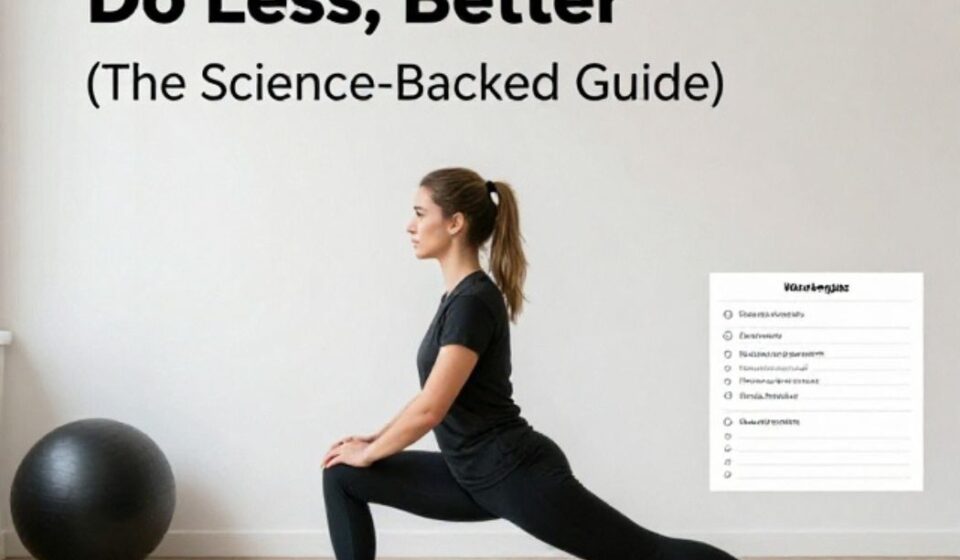
Achieve Fitness: Let me guess: you have a fitness app on your phone, a gym membership you rarely use, and a vague sense that you should be doing more. More cardio. More lifting. More steps. More discipline.
Here is the uncomfortable truth most fitness content won’t tell you: the biggest obstacle to achieving fitness in 2026 isn’t a lack of effort—it’s a misunderstanding of what actually works.
The evidence has shifted dramatically. The “no pain, no gain” gospel that dominated fitness culture for decades is being replaced by something far more nuanced and, frankly, more sustainable. Harvard researchers tracking nearly 150,000 adults over three decades found that just 90 to 120 minutes of strength training per week was linked to a 13% lower risk of premature death—and doing more than that provided no additional longevity benefit. Meanwhile, a growing body of research on “exercise snacks”—micro-bursts of movement scattered throughout the day—suggests that three minutes here and there can meaningfully improve cardiometabolic health, especially for people who hate traditional workouts.
The fitness industry doesn’t want you to know this because it’s hard to sell a program that says “do a little, consistently, and then stop.” But that’s exactly what the science is pointing toward.
In this guide, I’m going to walk you through what achieving fitness actually looks like in 2026—not the bro-science version, not the influencer version, but the version backed by the best available evidence and stripped of the noise. You’ll learn why the minimum effective dose matters more than maximum suffering, how to build a routine that survives real life, and what the latest trends mean for your body and your sanity.
Background: How We Got Here (And Why the Old Rules Broke)
For most of the 20th century, fitness advice was built on a military-industrial model: more volume, more intensity, more discipline. The aerobics boom of the 1980s gave way to the CrossFit era of the 2000s, which celebrated exhaustion as a proxy for progress. If you weren’t collapsing after a workout, you weren’t trying hard enough.
That model worked for a narrow slice of the population—mostly young, mostly male, mostly with unlimited recovery time and no children. For everyone else, it produced a predictable cycle: enthusiastic start, unsustainable intensity, injury or burnout, months of inactivity, guilt, repeat.
The science has been quietly correcting course. The World Health Organization’s 2020 guidelines, still the global standard in 2026, recommend 150 to 300 minutes of moderate aerobic activity per week (or 75 to 150 minutes of vigorous activity) plus two days of muscle-strengthening exercise. That’s it. That’s the baseline. Not six days a week in the gym. Not 20,000 steps. Not a 5 a.m. cold plunge followed by a sauna.
What changed isn’t just the prescription—it’s the understanding. We now know that:
-
Consistency beats intensity. An occasional heroic workout is less effective than frequent moderate activity, and cramming a week’s exercise into one session increases injury risk.
-
Strength training is not optional. Fewer than 30% of U.S. adults meet muscle-strengthening guidelines, yet resistance training is critical for bone density, metabolic health, and mobility across the lifespan.
-
Mental health is a primary outcome, not a side effect. One national survey found that 78% of exercisers cite mental or emotional well-being as their top reason for working out, ahead of physical fitness or appearance. The industry is finally catching up to what regular exercisers have known for years.
The New Framework: Four Pillars of Achievable Fitness
Forget the 12-week transformation. Achieving fitness in 2026 is about building a system that fits your actual life—not the fantasy version where you have unlimited time and energy. Here are the four pillars that matter.
Pillar 1: The Minimum Effective Dose (Why 90 Minutes of Strength Is the Sweet Spot)
Here’s a number that should reframe how you think about the gym: 90 to 120 minutes per week.
That’s the range Harvard researchers identified as optimal for longevity benefits from resistance training. Adults who hit that mark had a 13% lower risk of early death from any cause, a 19% lower risk from heart disease, and a 27% lower risk from neurological diseases like Alzheimer’s, compared with those who did no strength training. Crucially, doing more than 120 minutes per week didn’t add extra longevity benefit.
This is the minimum effective dose in action. Three 30-minute sessions. Two 45-minute sessions. A handful of bodyweight circuits squeezed between meetings. The form matters less than the consistency.
But here’s the nuance most coverage misses: the combination is where the magic happens. Participants who did both strength training and aerobic exercise had the lowest mortality risks in the study—up to 45% lower than those who did neither. You don’t need to choose between lifting and cardio. You need both, in moderate amounts.
Pillar 2: Zone 2—The Art of Going Slower to Get Fitter
Zone 2 cardio has been a buzzword for a few years now, but most people still misunderstand it. It’s not “easy cardio.” It’s a specific physiological state: 60% to 70% of your maximum heart rate, where you can still hold a conversation but you’re definitely working.
The benefits are real and well-documented. At this intensity, your body prioritizes fat oxidation for fuel. Your heart muscle strengthens, mitochondrial function improves, and capillary density around muscles increases. You build your aerobic base—the foundation that makes everything else possible.
Here’s the counterintuitive part: elite endurance athletes spend roughly 80% of their training time in Zone 2 and only 20% at high intensity. They figured out decades ago what recreational exercisers are only now discovering: you can’t build a high-performance engine without a strong, stable base.
The practical translation for a normal person: instead of turning every workout into a death match, spend most of your cardio time at a pace where you could chat with a friend. Brisk walking, easy cycling, steady swimming. Save the all-out efforts for once or twice a week. You’ll get fitter, recover faster, and actually enjoy it.
Pillar 3: Exercise Snacks—The Antidote to “I Don’t Have Time”
In 2025, a systematic review and meta-analysis of 14 studies involving 483 adults found that “exercise snacks”—brief bursts of high-intensity activity scattered throughout the day—significantly improved maximal oxygen uptake (a key marker of cardiovascular fitness) and reduced total and LDL cholesterol in physically inactive adults. The researchers concluded that this approach is “a practical solution for sedentary and inactive individuals or those with limited time”.
What counts as an exercise snack? Climbing stairs for 60 seconds. Doing 10 squats before your morning coffee. A 2-minute brisk walk after lunch. The structure is less important than the pattern: short, frequent bouts of movement that don’t require a change of clothes or a commute to the gym.
This is particularly powerful for the desk-bound among us. The CDC’s updated guidance emphasizes “move more and sit less” as a foundational principle—not because sitting is uniquely evil, but because replacing sedentary time with any movement produces measurable benefits. You don’t need a Peloton. You need to interrupt stillness.
Pillar 4: Recovery as a Skill (Not a Luxury)
The fitness industry has historically treated recovery as an afterthought—something you do when you’re injured, not something you train. In 2026, that’s changing. Wearable technology, which topped the ACSM’s annual fitness trends list for the third consecutive year, now measures recovery, stress, and biomarkers far beyond step counts. The message is clear: your body adapts during rest, not during work.
Harvard Health’s list of common workout mistakes includes a classic: not resting muscle groups. Muscles need at least 48 hours after a strength workout to recover and rebuild, yet many beginners work the same muscles every day and wonder why they’re constantly sore and not getting stronger. Alternating muscle groups or simply taking rest days isn’t laziness—it’s physiology.
The practical takeaway: if you’re strength training three times a week, you’re already at the sweet spot. If you’re doing more and feeling beat up, you’re probably not recovering enough to get the adaptations you’re training for.
Practical Tips: Building Your 2026 Fitness Routine
Enough theory. Here’s what this looks like in practice.
The Weekly Template (For a Busy Adult)
| Day | Activity | Duration | Why |
|---|---|---|---|
| Monday | Strength training (full body) | 30-40 min | Stimulates muscle, bone, metabolic health |
| Tuesday | Zone 2 cardio (brisk walk, easy bike) | 30-45 min | Builds aerobic base without taxing recovery |
| Wednesday | Exercise snacks + mobility | 5-10 min total | Interrupts sitting, maintains movement quality |
| Thursday | Strength training (full body) | 30-40 min | Second strength stimulus of the week |
| Friday | Zone 2 cardio | 30-45 min | Accumulates aerobic volume |
| Saturday | Active recreation (hike, swim, sport) | Variable | Enjoyment, social connection, movement variety |
| Sunday | Rest or gentle walk | Optional | Recovery |
This template hits the WHO guidelines (150+ minutes moderate cardio, 2+ strength sessions) while staying well within the 90-120 minute weekly strength sweet spot. It leaves room for life—missed workouts, sick days, travel.
How to Know You’re in Zone 2 Without a Gadget
The talk test is remarkably reliable. During Zone 2, you should be able to speak in full sentences but not sing. If you’re gasping between words, you’re above Zone 2. If you could comfortably read a book aloud, you’re below it. Aim for “comfortably challenged.”
Progressive Overload Without the Ego
The most common strength-training mistake Harvard identifies is lifting too much weight too soon. The fix is almost embarrassingly simple: use lighter weights and do more repetitions. Two or three sets of 20 reps with a 2-pound weight beats one set of five with a 5-pound weight for beginners. You’re teaching your nervous system the movement pattern before loading it heavily. Strength comes later. Technique comes first.
Common Mistakes (And How to Fix Them)
Mistake 1: Skipping the warm-up. Cold, stiff muscles tear more easily, especially as you age. Two minutes of marching in place and arm circles is enough to increase blood flow and elasticity.
Mistake 2: The weekend warrior cram. Cramming a week’s exercise into Saturday and Sunday increases injury risk without delivering the same benefits as distributed activity. Three 20-minute sessions beat one 60-minute session.
Mistake 3: Chasing soreness as proof of progress. Soreness is not a reliable indicator of workout quality. It often just means you did something unfamiliar. Consistent, moderate effort produces better long-term results than repeated bouts of self-destruction.
Mistake 4: Ignoring the data (or obsessing over it). Wearables are useful, but they’re also a source of what industry insiders call “data fatigue”. If tracking your metrics is making you anxious rather than informed, simplify. Steps and a weekly strength session are enough for most people.
The Balanced Analysis: Pros, Cons, and the Honest Tradeoffs
The Pros of the “Less, Better” Approach:
-
Sustainability: a routine you can maintain for decades beats a 12-week sprint every time.
-
Lower injury risk: moderate intensity and adequate recovery reduce wear-and-tear.
-
Mental health benefits: exercise becomes a stress reliever, not another source of pressure.
-
Time efficiency: 90 minutes of strength + 150 minutes of cardio per week is achievable for most people.
The Cons (Let’s Be Honest):
-
Slower visible results: if you’re chasing rapid physique changes, moderate training will feel frustratingly gradual.
-
Requires patience: the longevity data is compelling, but it doesn’t show up in the mirror next month.
-
Not optimal for advanced performance: if you’re training for a marathon or a powerlifting meet, you’ll need more volume and specificity than this framework provides.
-
The “exercise snack” evidence is still maturing: while the 2025 meta-analysis is promising, longer-term studies are needed to confirm sustained effects.
The Bottom Line: This approach is designed for the 80% of people who want to be healthy, functional, and reasonably fit—not for the 20% chasing podium finishes. If you’re in the latter group, you already know who you are, and you’re probably not reading this article.
The 2026 Landscape: Trends That Actually Matter
The ACSM’s 2026 trends report, based on surveys of roughly 2,000 fitness professionals, reveals a few shifts worth noting :
-
Wearables remain #1, but the conversation is shifting from “what should I track?” to “how do I interpret this data without losing my mind?”
-
GLP-1 medications are reshaping gym demographics. People on these drugs often arrive lighter but weaker, with less muscle mass. Gyms are responding with resistance training and nutrition support—a necessary correction to the “weight loss at any cost” mentality.
-
Exercise for mental health jumped two spots in the rankings. This isn’t a fad. It’s a recognition that the primary motivation for most exercisers isn’t aesthetics—it’s feeling sane.
-
Balance, flow, and core training are surging, particularly among aging populations and former high-intensity devotees who’ve realized that moving well matters more than moving heavy.
The through-line? Fitness in 2026 is about quality of life, not just quantity of effort.
Conclusion: The Fitness You Can Actually Achieve
Achieving fitness isn’t about finding the perfect program. It’s about building a practice that survives contact with reality. The evidence is clear: moderate, consistent, combined strength and cardio training—supplemented by brief movement snacks and genuine recovery—produces the vast majority of health benefits most people will ever need.
Key Takeaways
-
90–120 minutes of weekly strength training is linked to significantly lower mortality risk; more is not necessarily better.
-
150–300 minutes of moderate cardio (Zone 2 for most of it) builds your aerobic base without burning you out.
-
Exercise snacks—short bursts of movement throughout the day—improve cardiometabolic health, especially for inactive adults.
-
Combine strength and cardio for the biggest longevity benefit: up to 45% lower risk of early death compared with doing neither.
-
Recovery is training. Muscles need 48 hours between strength sessions. Sleep and rest days are when adaptation happens.
-
Mental health is a legitimate fitness goal. Most exercisers say it’s their primary motivation. Design your routine around how you want to feel, not just how you want to look.
Frequently Asked Questions
Q: Is 90 minutes of strength training per week really enough?
For general health and longevity, yes. The Harvard study found that 90–120 minutes weekly was associated with significant mortality benefits, and additional time beyond 120 minutes didn’t add further longevity advantage. If your goals include maximal muscle gain or athletic performance, you’ll need more volume—but for healthspan, the sweet spot is real.
Q: Can exercise snacks replace a full workout?
Not entirely. Exercise snacks are excellent for interrupting sedentary time and improving cardiometabolic markers in inactive people . But they don’t replace the structured strength training and sustained aerobic work that build substantial fitness. Think of them as a supplement, not a substitute.
Q: How do I know if I’m in Zone 2 without a heart rate monitor?
Use the talk test. You should be able to speak in complete sentences but not sing. If you’re gasping, you’re above Zone 2. If you could read aloud comfortably, you’re below it.
Q: What if I miss a workout?
Nothing happens. Seriously. The consistency that matters is measured in weeks and months, not individual days. Harvard’s guidance on common mistakes emphasizes that cramming missed sessions together increases injury risk. Just resume your normal schedule at the next opportunity.
Q: Is strength training safe for older adults?
Yes—and it’s especially important. Resistance training helps maintain bone density, metabolic health, and mobility across the lifespan. Bodyweight exercises, resistance bands, and light dumbbells are effective starting points. The Harvard longevity study included participants in middle age and older, and the benefits were clear.
Q: Do I need a wearable to achieve fitness?
No. Wearables are useful tools for tracking trends and building awareness, but they’re not necessary. The talk test, a simple timer, and a notebook work fine. If tracking your data makes you anxious or obsessive, skip it.
Sources
This article draws on the following sources:
-
HonorHealth Physicians — “Promoting physical activity in patients: Evidence-based guidelines” (2024). Summarizes WHO, AHA, ACSM, and CDC recommendations for aerobic, strength, and balance training.
-
European PMC — “Effects of Exercise Snacks on Cardiometabolic Health and Body Composition in Adults: A Systematic Review and Meta-Analysis” (2025). Twelve RCTs and two non-RCTs, 483 adults.
-
Harvard T.H. Chan School of Public Health — “Moderate amount of strength training each week could boost longevity” (2026). Study of ~150,000 adults over 30 years, published in British Journal of Sports Medicine.
-
Cleveland Clinic — “What Is Zone 2 Cardio?” (2025). Expert commentary from exercise physiologist Christopher Travers, MS.
-
Harvard Health — “6 mistakes that sabotage your workout” (2025). Practical guidance on warm-ups, consistency, weight selection, rest, hydration, and posture.
-
ISSA — “Fitness Industry Roundup — July 2026” (2026). ACSM trends, AI coaching statistics, GLP-1 impacts, and gym participation data.
-
ACSM — “The Future of Fitness: ACSM Announces Top Trends for 2026” (2025). Official trends report with expert commentary.
-
CDC guidance summary (via WeChat public account, 2025). Physical activity recommendations and “move more, sit less” principle.
-
ScienceDirect — “A systematic review of exercise snack interventions on multidimensional health benefits” (2026). Review of 23 empirical reports, 2014–2026.
-
Harvard Health — “Strength training over decades linked to longer life” (2026). Summary of the BJSM study with practical recommendations.
-
Vanderbilt Health — “Should I try Zone 2 training?” (2025). Explanation of the 80/20 training principle and practical Zone 2 guidance.
-
IDEA Health & Fitness Association — Technology and coaching articles (2026). Context on wearables, AI, and data fatigue.
FOR FURTHER INFORMATION, VISIT: THELUXURYLIFEMAGAZINE.COM