
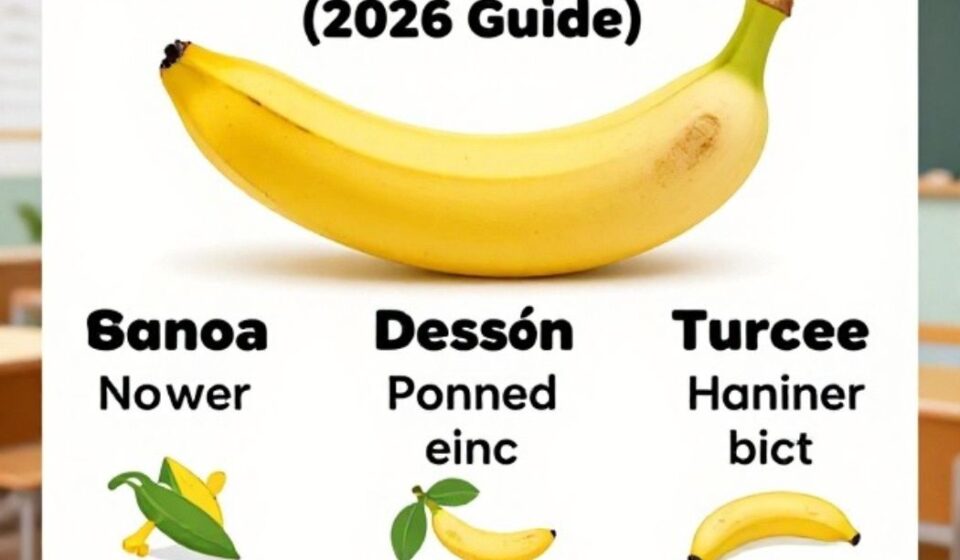
Banana in Spanish: If you ask a Spanish speaker how to say “banana,” you will not get one answer. You will get an argument. The word changes dramatically depending on whether you are in Madrid, Mexico City, Buenos Aires, or Caracas. The most widely understood term is plátano, but it often refers to the starchy cooking plantain rather than the sweet dessert fruit. In Argentina and Uruguay, it is banana. In Venezuela, it is cambur. In much of Central America and the Caribbean, it is guineo. And in the Andes and parts of Central America, it is banano. This guide breaks down the regional map, the botanical confusion, and the practical phrases you actually need to know.
Introduction: The Breakfast That Started a Linguistic Crisis
Imagine you are sitting at a café in Buenos Aires. You order a fruit salad. You want to ask for a banana on the side. You confidently use the word you learned in high school Spanish class: plátano. The waiter looks at you, slightly confused, and says, “Ah, you mean banana?”
You try again in Mexico City. You ask for a banana. The vendor smiles and hands you a plátano. Then you travel to Caracas, and suddenly everyone is talking about cambures. By the time you reach San José, Costa Rica, the word has shifted again to guineo.
This is not a failure of your Spanish. It is a feature of it. The banana—a fruit that traveled from Southeast Asia to the Americas only a few centuries ago—has become one of the most fiercely localized words in the Spanish language. Understanding why this happened, and which word to use where, is a masterclass in how language, history, and agriculture collide.
Background: Why Is “Banana” So Complicated in Spanish?
The Fruit That Arrived After the Language
The word for “banana” is messy because the banana itself arrived in the Spanish-speaking world relatively late. The Diccionario de la lengua española notes that banana is a voice from the Congo, entering Spanish through Portuguese or English. The fruit reached the Americas in the early 16th century, after Spanish was already established.
When a new food arrives, speakers do not invent a new word from nothing. They borrow, adapt, or repurpose existing ones. In Spain, speakers borrowed plátano from the Latin platanus—the plane tree—because the banana plant’s broad leaves reminded them of that European shade tree. This was, as one historical linguist notes, not entirely accurate; even 16th-century chroniclers knew the banana was not a plane tree.
Meanwhile, in the Americas, different regions borrowed from different sources. Cambur in Venezuela likely has African roots. Guineo references Guinea, the West African region associated with the slave trade and early banana cultivation. Banano and banana came through Portuguese and English trade routes.
The Plantain Problem
The confusion is compounded by the fact that Spanish speakers often distinguish between the sweet dessert banana and the starchy cooking plantain. English uses two words. Spanish, in many regions, uses the same word (plátano) for both, relying on context or modifiers like plátano macho or plátano de freír to clarify.
In Colombia, for example, plátano typically refers to the cooking plantain, while banano is the sweet fruit you eat raw . In Mexico, plátano is the sweet banana, and the plantain is often called plátano macho. This distinction matters when you are shopping, cooking, or ordering.
The Regional Map: What to Say and Where
| Region / Country | Common Word | Notes |
|---|---|---|
| Spain | Plátano | Also used for plantain; the default term in European Spanish. |
| Mexico | Plátano | Sweet banana; plantain is plátano macho. |
| Argentina, Uruguay, Paraguay | Banana | Pronounced “bah-NAH-nah.” |
| Venezuela | Cambur | The undisputed local champion. |
| Colombia | Banano (sweet) / Plátano (plantain) | A clear lexical distinction. |
| Central America (Guatemala, El Salvador, Honduras, Nicaragua, Costa Rica) | Guineo / Banano | Usage varies by country and context. |
| Cuba, Dominican Republic, Puerto Rico | Guineo | The Caribbean standard. |
| Ecuador, Peru, Bolivia | Plátano / Banano | Mixed usage; plátano is widely understood. |
| Chile | Plátano | Often distinguishes by size: plátano (small) vs. banana (large). |
Sources:
In-Depth Analysis: The Three Big Questions
1. Is “Plátano” the Safest Choice?
Yes—with a caveat.
If you learn one word, learn plátano. It is understood in virtually every Spanish-speaking country, from Madrid to Buenos Aires to Mexico City. It appears in menus, recipes, and supermarket signs across the Spanish-speaking world.
The caveat: plátano often carries the meaning of “plantain” or a starchy, cooking variety, especially in Colombia, the Caribbean, and parts of Central America. If you ask for a plátano expecting a sweet, yellow dessert banana in Bogotá, you may get a green, firm fruit meant for frying. In those contexts, ask for a banano if you want the sweet version.
Practical tip: In Spain, plátano is unambiguously the sweet banana you eat raw. In Latin America, pay attention to local usage.
2. Why Do Argentina and Uruguay Say “Banana”?
The Southern Cone is the odd one out. While most of Latin America uses plátano, banano, or guineo, Argentina, Uruguay, and Paraguay have adopted banana directly.
The reason is historical and commercial. The Southern Cone had closer trade ties with Brazil and Europe in the 19th and early 20th centuries, and the Portuguese/English word banana entered through those channels. The Diccionario de la lengua española lists banana as the standard term in Argentina, Paraguay, and Uruguay, while also noting its use in Colombia and Ecuador for the plant.
For learners, this is actually good news: if you already know the English word, you have a head start in Buenos Aires. Just pronounce it with Spanish vowels: bah-NAH-nah.
3. What About “Cambur” and “Guineo”?
These are the words that make Spanish learners feel like they have failed. They have not. They have simply encountered regionalisms—words that are deeply local and carry cultural identity.
-
Cambur (Venezuela): This is the standard, everyday word in Venezuela. It appears in supermarkets, recipes, and casual conversation. Its etymology is debated; some trace it to Guanche (Canary Islands) roots, others to African origins. For Venezuelans, cambur is not a quirky alternative—it is the word.
-
Guineo (Caribbean and Central America): This term likely derives from “Guinea,” referencing the West African coast. It is the dominant word in Cuba, the Dominican Republic, Puerto Rico, El Salvador, and parts of Honduras and Nicaragua. In some regions, guineo specifically refers to a smaller, sweeter variety sometimes called a “finger banana” or “baby banana”.
A note on banano: This word is common in the Andes and Central America, particularly Colombia, where it distinguishes the sweet export banana from the cooking plantain. The Diccionario de americanismos confirms its use across Guatemala, Honduras, El Salvador, Nicaragua, Costa Rica, Panama, Colombia, Peru, and Argentina.
Practical Tips: How to Navigate the Banana aisle
If You Are Traveling
-
Do not assume plátano means “sweet banana.” In many countries, it means plantain. If you want the sweet, yellow fruit, say banano (Colombia, Central America) or banana (Southern Cone) or guineo (Caribbean). When in doubt, describe it: “el fruto amarillo, dulce, que se come crudo” (the yellow fruit, sweet, eaten raw).
-
Listen before you speak. In a Venezuelan market, you will hear cambur everywhere. In a Cuban café, guineo. Use the local word, and you will get a smile—and the right fruit.
-
For plantains, use plátano or plátano macho. If you want the starchy fruit for frying (tostones, maduros), plátano is your word almost everywhere.
If You Are Cooking
-
Banana bread is pan de plátano in most recipes, regardless of the regional word for the fruit itself.
-
A banana split is banana split in Spanish, borrowed directly from English, though some menus might say plátano con helado.
-
To “go bananas” is volverse loco or ponerse como loco—do not try to translate the fruit literally.
Common Mistakes (and How to Avoid Them)
Mistake #1: Using plátano for a sweet banana in Colombia.
In Colombia, plátano is the cooking plantain. If you want a sweet snack banana, ask for a banano. Using the wrong word will get you a green, firm fruit that is not pleasant to eat raw.
Mistake #2: Assuming banana is universal because it looks like English.
It works in Argentina, Uruguay, and Paraguay. In Mexico or Spain, using banana will mark you as a foreigner, though you will likely be understood. Use plátano in those regions.
Mistake #3: Thinking guineo is a “less correct” word.
It is not. It is the standard word for millions of Spanish speakers in the Caribbean and Central America. Language hierarchies are a myth; regional usage is the only rule that matters.
Mistake #4: Forgetting the false friend.
Plátano also means “plane tree” in Spanish, the shade tree of European plazas. Context makes the meaning clear, but it is a fun etymological quirk to know.
Pros, Cons, and a Balanced View
The Pros of Regional Diversity
-
Cultural richness: The variety of words reflects the complex history of migration, trade, and agriculture in the Spanish-speaking world. Cambur, guineo, and plátano are not “wrong”—they are living history.
-
Precision: In regions that distinguish plátano (plantain) from banano (sweet banana), the vocabulary is more precise than English, which uses one word for the sweet fruit and another for the cooking variety but often confuses them.
-
Local connection: Using the local word is a sign of respect and cultural awareness. It opens doors.
The Cons (for Learners)
-
Memorization burden: You cannot learn one word and be done. You need a mental map of regions.
-
Miscommunication risk: Ordering the wrong fruit is a minor inconvenience; misreading a recipe is worse. A recipe calling for plátano in Colombia expects a starchy plantain, not a sweet banana.
-
Dictionary lag: Many textbooks still teach only plátano and ignore the regional diversity. Learners are often unprepared for the reality of the Spanish-speaking world.
The Balanced Take: The diversity is not a problem to be solved. It is a feature of the language. Learn plátano as your foundation, then layer in regional words as you travel or interact with speakers from different countries. The effort pays off in cultural connection.
Future Trends: Will “Banana” Ever Standardize?
As of 2026, there is no sign of standardization. If anything, regional identities are strengthening. Social media and streaming content have made Spanish speakers more aware of each other’s vocabulary, but awareness has not led to homogenization. A Venezuelan content creator will still say cambur; a Mexican chef will still say plátano.
What is changing is the global banana itself. Climate change and disease (particularly Tropical Race 4, a fungal disease affecting the Cavendish variety) are threatening commercial banana production. If the global banana supply chain shifts—toward more diverse varieties or different growing regions—the vocabulary may shift too. New varieties may enter Spanish-speaking markets with new names, adding further layers to this already complex lexical landscape.
For now, the best strategy is curiosity. Treat every new word for “banana” as a window into a region’s history, not as an obstacle to fluency.
Key Takeaways
-
The most widely understood word is plátano, but it often means “plantain” rather than the sweet dessert banana.
-
Regional words matter: Banana (Argentina, Uruguay, Paraguay), cambur (Venezuela), guineo (Caribbean, Central America), banano (Andes, Central America, Colombia).
-
Colombia makes a useful distinction: Banano = sweet banana; Plátano = cooking plantain.
-
Do not fear regionalisms. Using cambur in Caracas or guineo in San Juan is not a mistake—it is fluency in action.
-
When in doubt, describe the fruit rather than relying on a single word: “el fruto amarillo y dulce” works everywhere.
Frequently Asked Questions About Banana in Spanish
Q: What is the most common Spanish word for “banana”?
A: Plátano is the most widely understood term across the Spanish-speaking world. However, in many regions it refers to the cooking plantain rather than the sweet dessert banana. For the sweet fruit, banano, banana, guineo, and cambur are common depending on the country.
Q: Is it offensive to use the “wrong” regional word?
A: No. Spanish speakers are accustomed to regional variation and will generally understand you regardless of which word you use. Using the local word is a friendly gesture, but not using it is not an insult.
Q: How do you say “banana” in Mexico?
A: Plátano. In Mexico, the sweet banana is plátano, and the larger cooking plantain is often called plátano macho.
Q: What is the difference between plátano and banano in Colombia?
A: In Colombia, plátano typically refers to the starchy cooking plantain, while banano is the sweet banana eaten raw. This distinction is widely observed in Colombian markets and households.
Q: How do you say “banana bread” in Spanish?
A: Pan de plátano is the most common translation, though in the Southern Cone you might see pan de banana. The word for the fruit changes, but the recipe name tends to follow the dominant regional term.
Q: Is guineo the same as a “baby banana”?
A: In some regions, guineo refers specifically to a smaller, sweeter variety of banana, sometimes called a “finger banana.” In others, it is simply the general word for banana. Context and local usage determine the precise meaning.
Sources
-
Real Academia Española, Diccionario de la lengua española (entries for banana, banano, plátano)
-
Asociación de Academias de la Lengua Española, Diccionario de americanismos (entry for banano)
-
SpanishDictionary.com, “Banana in Spanish” and community discussions
-
Academic linguistic analysis of banana terminology in Spanish (DNB archive)
-
Pearson ELT Argentina, “¿Guineo, Plátano o Banana?”
-
Papers Past (National Library of New Zealand), historical etymology of “banana”
FOR FURTHER INFORMATION, VISIT: THELUXURYLIFEMAGAZINE.COM