
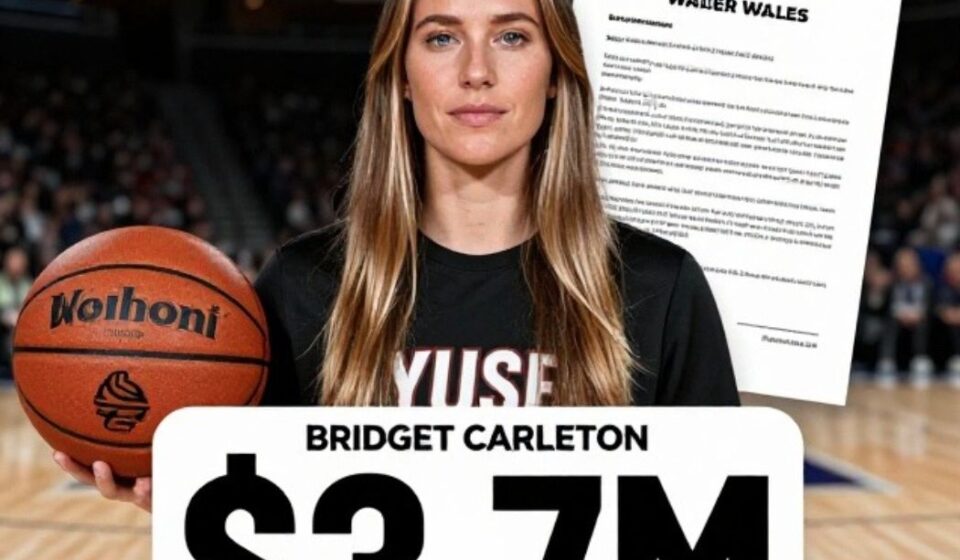
What does a WNBA “bust” look like?
In 2019, Bridget Carleton was drafted 21st overall by the Connecticut Sun, played four games, and got cut. By August, she was signing a seven-day contract with the Minnesota Lynx just to stay in the league. If you had told a basketball fan then that seven years later she would be the first player selected in an expansion draft, sign a three-year, $3.7 million max contract, and become the face of a franchise in Portland, they would have laughed.
But here is the number that matters more: 90. As of August 2026, Carleton ranked fifth in the entire WNBA in three-pointers made—not for a contender, but for an expansion team that had won just a handful of games. She was doing it on career-high usage, with defenses keyed to stop her every single night.
Carleton’s story is not a fairy tale about talent finally getting “discovered.” It is a case study in something rarer: the systematic, unglamorous conversion of a role player’s skills into a star’s production. Whether you are a hoops obsessive, a fantasy manager, or someone who just loves a good underdog arc, her 2026 season offers lessons about patience, fit, and the invisible work that precedes every breakout.
Background: From Chatham to the Fringe
Bridget Carleton grew up in Chatham, Ontario—a small city about an hour east of Detroit, closer to American basketball culture than to Toronto’s media machine. She stayed home for college? No. She went to Iowa State, where she became the program’s all-time leading scorer with 2,142 points, won Big 12 Player of the Year, and earned All-America honors as a senior in 2019.
None of that guaranteed a WNBA career.
Her rookie season was a crash course in the league’s ruthlessness. Connecticut drafted her in the second round, gave her four appearances, and waived her. Minnesota picked her up on a short-term deal, and she spent the next several seasons oscillating between the bench, the rotation, and—briefly—a genuinely important role. By 2024, she had carved out a reputation as a reliable 3-and-D forward: she started 34 games, averaged 9.6 points, shot 44.4% from deep, and finished third in Most Improved Player voting.
Then 2025 happened. Her minutes stayed high, but her scoring dipped to 6.5 points per game. She was valuable, but she was a supporting piece on a Lynx team with championship aspirations.
When the WNBA announced expansion to Portland and Toronto for 2026, Carleton’s name was not the first that casual fans mentioned. It should have been. Portland’s front office understood something the box scores obscured.
The Expansion Draft Gamble: Why Portland Chose Her First
On April 3, 2026, the Portland Fire used the No. 1 pick in the expansion draft on Carleton. The immediate reaction from some corners was confusion. She was 28, coming off a down scoring year, and slated for free agency. Why not take a younger upside swing?
The answer lies in how expansion teams actually succeed. They do not win by hoarding raw talent; they win by establishing a culture, a style, and a player who can absorb volume without breaking. Portland’s general manager, Vanja Cernivec, and head coach, Alex Sarama, saw a player whose efficiency had survived years of inconsistent roles—and who was hungry for more.
The mechanics mattered too. Because Carleton was a pending unrestricted free agent, Portland used its one designated “potential unrestricted free agent” slot on her, securing exclusive negotiating rights. They then signed her to a three-year max deal worth $3.7 million, with a reported $1.19 million salary in 2026. It was a bet that a 6-foot-2 forward with a quick release and a high basketball IQ could scale her game if given the keys.
The bet paid off immediately. In just her second game with Portland, Carleton scored a career-high 26 points against the New York Liberty—which also happened to be the Fire’s first WNBA win since the original Portland franchise folded in 2002.
The 2026 Leap: What Changed When the Usage Went Up
Here is where Carleton’s story becomes genuinely instructive for anyone who cares about player development.
In Minnesota, Carleton averaged 3.1 three-point attempts per game over her Lynx career. In Portland, that number jumped to 7.4. Her usage rate—the percentage of team possessions she ended while on the floor—hit a career-high 20.6%. Common sense says efficiency should crater when a player shoots twice as often against defenses designed to stop her.
It didn’t.
Carleton shot 36.8% from three in 2026, a modest dip from her 2024 mark but remarkable given the difficulty of her attempts. Coach Sarama has repeatedly pointed to advanced metrics showing her shooting better on harder shots—off the dribble, coming off movement, with tighter contests. She also posted an 8.8% turnover rate, elite for a player handling the ball far more than ever before.
The most revealing stat: she led the WNBA in made threes after the All-Star break. That is not the profile of a player who faded under pressure. That is a player who learned pressure and got comfortable with it.
Her final season averages—14.6 points, 4.5 rebounds, 2.1 assists, and 1.6 steals per game—represented roughly a 150% increase in scoring from her 2025 output. Sarama publicly campaigned for her as Most Improved Player, noting that only a handful of players in league history have doubled their usage while maintaining or improving efficiency.
The International Dimension: Why Canada Matters to Her Game
One overlooked factor in Carleton’s development is her commitment to the Canadian national team. She has been a fixture with Canada’s senior squad, earning All-Star Five honors at the 2022 FIBA World Cup. In March 2026, during FIBA World Cup qualifying, she dropped a game-high 24 points against Turkey in a narrow loss, nearly erasing a 19-point deficit.
For WNBA players, international competition often serves as a laboratory. With Canada, Carleton is asked to be a primary scorer and decision-maker in ways the Lynx never demanded. Those reps—against physical European defenses, in high-stakes qualifying games—built the confidence she carried into Portland’s training camp.
She also spent the 2025-26 European season with ZVVZ USK Praha in the Czech Republic, winning a league championship and averaging 13.3 points and 5.2 rebounds. In January 2026, she hit nine three-pointers in a single EuroLeague game, a modern record for the competition. The message was clear: when given volume, Carleton produces.
Practical Takeaways: What Carleton’s Arc Teaches About Player Fit
If you are evaluating basketball talent—whether for fantasy, coaching, or just understanding the game—Carleton’s 2026 season offers a framework that most analyses miss.
1. Efficiency in a small role predicts success in a large one—with a caveat
Carleton’s shooting percentages in Minnesota were good but not gaudy. What mattered was how she got them: movement threes, quick decisions, low turnovers. Those are scalable skills. A player who needs the ball in isolation to score rarely scales cleanly. A player who scores within flow can absorb more possessions without disrupting an offense.
2. Turnover rate is the quietest star metric
Carleton’s 8.8% turnover rate on career-high usage is the statistical signature of a player who does not waste possessions. For an expansion team with limited margin, that reliability is worth more than raw explosiveness.
3. Age 28 is not “old” for a late bloomer
The WNBA’s history is full of players who peaked at 27–30 because their games relied on craft rather than athleticism. Carleton’s 2026 leap at age 28 (she turned 29 in May) is unusual only because we expect breakouts to happen earlier. Her game—spot-up shooting, cutting, positional defense—ages well.
Common Mistakes and Challenges (And How Carleton Navigated Them)
Mistake 1: Confusing “role player” with “limited player.”
Many analysts wrote Carleton off as a system beneficiary in Minnesota. The Portland bet was essentially a rejection of that label. The lesson: a player’s ceiling is often determined by opportunity as much as ability. Carleton did not suddenly develop new skills; she applied existing ones at a higher volume.
Mistake 2: Ignoring the value of locker-room presence.
Carleton hosted a team dinner in Toronto during Portland’s first road trip. She talked openly about building chemistry on an expansion roster full of strangers. Coach Sarama cited her culture-setting as a primary reason she was drafted. In expansion environments, talent alone fails without connectors.
Challenge: The weight of being “the first.”
As Portland’s first-ever draft pick and highest-paid player, Carleton carried expectations no previous team had placed on her. The early season had rocky moments—the Fire’s playoff hopes faded by midseason. The solution was not a single adjustment but a recalibration of what success meant: individual development and competitive integrity over wins and losses.
Pros, Cons, and a Balanced Look at the Portland Era
Pros of Carleton as a franchise cornerstone:
-
Scalable skill set: Elite shooting and low turnovers translate to any system.
-
Professional maturity: Seven WNBA seasons, international experience, and a reputation for adaptability.
-
Defensive reliability: Her 1.6 steals per game in 2026 reflected improved positioning and anticipation, not gambling.
-
Contract value: A max deal for a player producing at an above-average starter level is fair market value, not an overpay.
Cons and risks:
-
Age curve: She turns 30 in May 2027. Her game should age gracefully, but athletic decline is inevitable.
-
Scoring ceiling: Carleton is a highly efficient complementary scorer, not a primary shot-creator who can break down elite defenses in isolation. Portland will eventually need a dynamic guard to pair with her.
-
Sample size: One season of star-level production is promising, not conclusive. Regression is possible, especially if Portland adds a higher-usage teammate.
The balanced view: Portland’s investment looks shrewd, not because Carleton is a superstar, but because she is the right kind of player for a young franchise: stable, coachable, efficient, and genuinely invested in the community. She raises the floor while the front office searches for the ceiling.
Future Trends: What Comes Next for Carleton and Portland
The 2027 season will be the real test. Portland will have another year of draft capital and free agency to add talent. If the Fire land a high-usage guard or wing, Carleton’s volume will likely dip—but her efficiency could climb back toward her 2024 levels. That is not a regression; it is a sign of a functional team.
The more intriguing possibility is that Carleton’s 2026 season changes how expansion teams evaluate unprotected players in future drafts. The old logic favored youth and “potential.” The Carleton experiment suggests that proven, scalable role players in their late 20s may be undervalued assets—players who can stabilize a franchise while it builds.
For Carleton personally, the next milestone is a playoff appearance. Portland’s inaugural season did not deliver that, but the foundation is in place. If the Fire contend in 2027 or 2028, her legacy as the first true Portland basketball star of the modern WNBA era will be secure.
Key Takeaways (Quick Summary Box)
-
Bridget Carleton went from a waived second-round pick in 2019 to the No. 1 selection in the 2026 WNBA expansion draft.
-
Her 2026 stats—14.6 PPG, 4.5 RPG, 36.8% from three—represented a dramatic leap driven by increased usage, not new skills.
-
Portland’s three-year, $3.7 million investment was a bet on scalability, efficiency, and culture—and it paid off.
-
Her low turnover rate (8.8%) on career-high usage is the most underrated stat of her season.
-
The Carleton model suggests expansion teams should value proven, scalable veterans over raw youth.
Detailed FAQs
Q: How old is Bridget Carleton?
She was born May 22, 1997, making her 29 years old as of late 2026.
Q: What position does Bridget Carleton play?
She is listed as a forward at 6-foot-2 (188 cm) and has played both small forward and power forward in smaller lineups.
Q: Did Bridget Carleton win a WNBA championship?
No. She won the Commissioner’s Cup with the Minnesota Lynx in 2024 and reached the WNBA Finals that season, but has not won a league championship.
Q: What is Bridget Carleton’s contract with the Portland Fire?
She signed a three-year, $3.7 million max contract in free agency after being selected first overall in the 2026 expansion draft.
Q: How did Bridget Carleton play in her first game against the Toronto Tempo?
She scored 15 points on 4-of-8 shooting from three in Portland’s 99-80 win over Toronto on May 23, 2026.
Q: Is Bridget Carleton playing for Canada in the 2026 FIBA World Cup?
Yes. She participated in Canada’s qualifying tournament in March 2026, averaging 13.4 points and 5.2 rebounds per game in the qualifiers.
Sources
-
WNBA official announcement of Carleton’s signing with Portland Fire
-
Sporting News analysis of Carleton’s 2026 season and contract value
-
The Sarnia Observer / The Observer coverage of Carleton’s expansion draft and early Portland role
-
CBC Sports reporting on FIBA World Cup qualifying
-
Basketball-Reference and RealGM statistical profiles
-
The Globe and Mail / Toronto Star coverage of Carleton’s leadership and early season performance
-
Iowa State Athletics profile on Carleton’s overseas and professional career
-
Reuters report on the 2026 WNBA expansion draft
-
FIBA official player profile for the 2026 qualifying tournament
-
Wikipedia career overview (used for college and early professional timeline, cross-referenced with primary sources)
FOR FURTHER INFORMATION, VISIT: THELUXURYLIFEMAGAZINE.COM